


MEET OUR SISTER SPECIES · No. 1
The Bird That Looks Like a Party
March 23, 2026
Posted by: Tom Newmark
Keel-Billed Toucan: Ramphastos sulfuratus
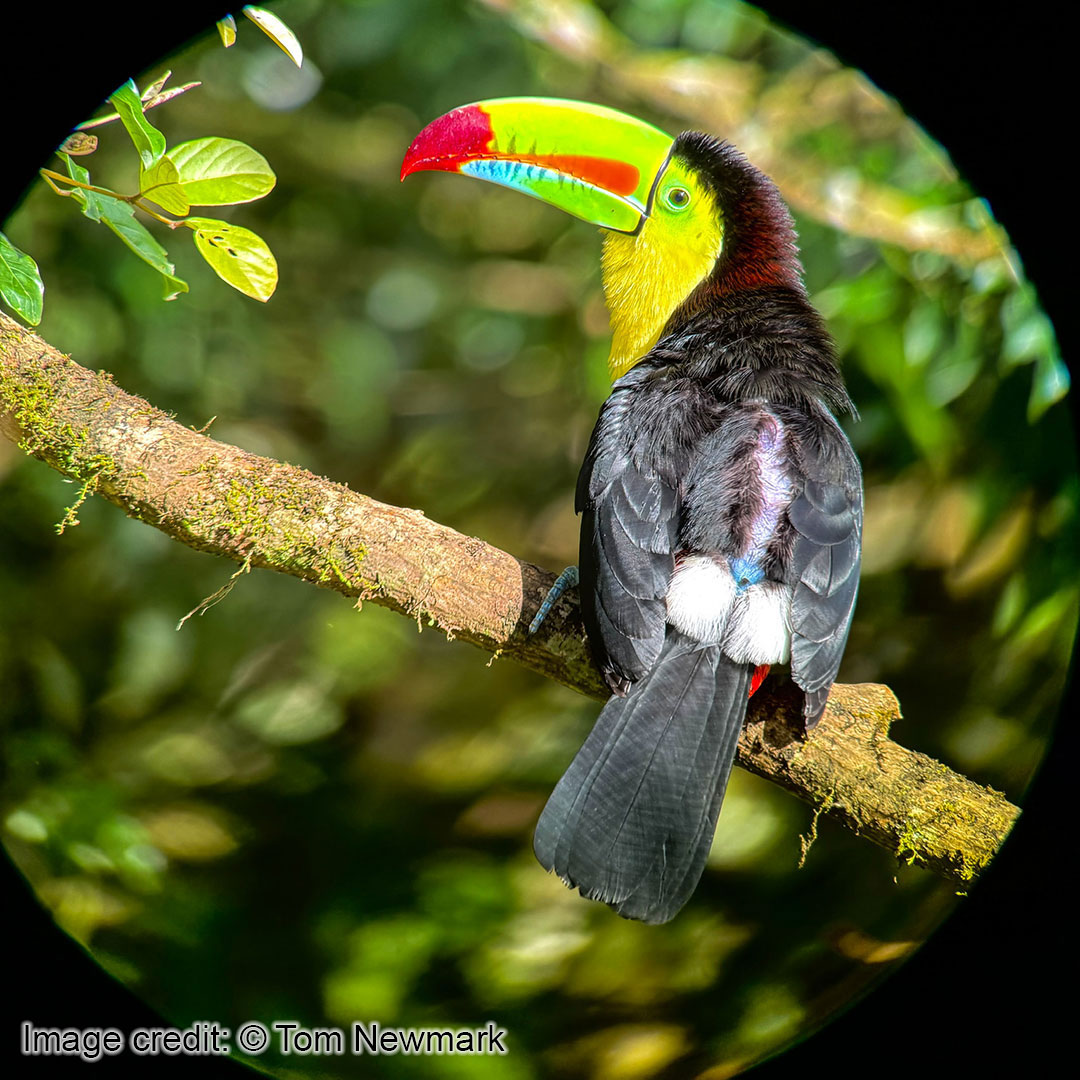
Keel-billed toucan (Ramphastos sulfuratus) photographed through a spotting scope — Finca Luna Nueva Lodge, Costa Rica · Photo: Tom Newmark
You hear them before you see them. A dry, mechanical croaking — somewhere between a frog and a ratchet — echoes through the canopy above the lodge. Then a flash of movement, and suddenly there it is: a bird so improbably colored that your first instinct is to look for the artist who painted it.
The keel-billed toucan does not do subtle.
Ramphastos sulfuratus is one of Costa Rica’s most iconic birds — and at Finca Luna Nueva Lodge, on the Caribbean slope of the Tilaran mountain range, it is also a neighbor. A loud, spectacular, fruit-tossing neighbor who shows up uninvited to breakfast and somehow makes everything better.
Quick Facts:
Keel-Billed Toucan
| Scientific name: | Ramphastos sulfuratus |
| Family: | Ramphastidae |
| Length: | 42–55 cm (17–22 in) |
| Bill length: | Up to 20 cm — roughly one-third of total body length |
| Weight: | 380–500 g |
| Lifespan: | Up to 20 years in the wild |
| Range: | Southern Mexico to northern Colombia and Venezuela |
| Habitat: | Humid lowland and foothill forest, forest edge, Caribbean slope |
| Diet: | Fruit (primary), insects, lizards, eggs, small birds |
| Status: | Least Concern (IUCN) — locally common in suitable habitat |
A Bill That Does Everything
That bill — lime green, sky blue, orange, and red — accounts for roughly one-third of the toucan’s total body length. It is a sweeping, lightweight masterpiece of keratin that looks heavy and is not. The bill’s interior is a honeycomb of hollow bone, making it strong, rigid, and almost weightless.
It is also, as scientists have discovered, a world-class thermal regulation tool. Toucans shunt blood into the bill to release body heat, much the way an elephant uses its ears. That chromatic explosion is not vanity. It is air conditioning.
Fruit Tossing and Seed Dispersal
Watch a keel-billed toucan eat and you understand the bill immediately. It plucks a fruit, flips it into the air, tips its head back, and catches it mid-fall. Precise. Practiced. They have been doing this for millions of years. And because they swallow fruit whole and disperse the seeds across wide distances in their wake, they are among the most important reforesters in the rainforest ecosystem. At Finca Luna Nueva, where regenerative agriculture and forest restoration are at the center of everything we do, that matters. The toucans are not guests here. They are co-farmers.
Keel-Billed Toucans at Finca Luna Nueva Lodge
Finca Luna Nueva sits at approximately 350 meters on the Caribbean slope — precisely the humid foothill forest habitat that keel-billed toucans favor. They are year-round residents here, moving through the farm’s fruiting trees, the forest edge trails, and the canopy above the open-air lodge dining area with casual confidence.
A family group of three or four calling from the cecropia trees above breakfast is not unusual. Neither is watching one chow down on ripe bananas near the pool, entirely unconcerned about the audience it has attracted.
Finding them is simple: look up. Wherever there is ripe fruit on the farm — and on a working tropical farm there is almost always ripe fruit somewhere — there is a good chance a keel-billed toucan already knows about it.
Costa Rica, Biodiversity, and Why This Bird Belongs Here
Costa Rica protects more than 25 percent of its national territory in parks and reserves. The result is one of the highest concentrations of bird species per square kilometer on Earth — more than 900 species in a country smaller than West Virginia.
The keel-billed toucan is currently listed as Least Concern by the IUCN, but that status reflects population totals, not local pressures. Habitat fragmentation, particularly in Caribbean lowland forests, is real. Farms that maintain forest corridors — as Finca Luna Nueva does, connected to a protected complex of more than 100,000 acres including the Children’s Eternal Rainforest — provide critical refuge for species that need large territories to thrive.
When you watch a toucan work its way through our canopy, you are watching a small argument for why regenerative land use matters.
Come and Listen for the Ratchet in the Canopy
Costa Rica is famous for its biodiversity. Travel guides will list the species, the parks, the probabilities. But there is a difference between knowing that keel-billed toucans exist in Costa Rica and standing under a cecropia tree at Finca Luna Nueva while one of them tosses fruit three meters above your head, regarding you with an expression of mild, regal indifference.
Some birds inspire field guides. This one inspires wonder.
Stop. Look up. Give yourself a moment. You came a long way for this, and it is worth every second.

