


Birding at the Edge

Birding at the Edge
Avian Biodiversity at the Junction of the Rainforest and Regeneration
Why 364 species on a single Costa Rican farm is not an accident — it is a lesson in ecology.
AT A GLANCE:
Finca Luna Nueva Lodge
| Location: | San Isidro de Peñas Blancas, Alajuela, Costa Rica |
| Coordinates: | 10.3886° N, 84.5967° W |
| Elevation: | 1,080–1,150 ft (329–351 m) — Caribbean mountain slope |
| eBird Hotspot: | L1873352 — 364 species recorded |
| Property: | 127 acres total — approx. 60% protected rainforest; balance in farmland, secondary forest & gardens |
| Wildlife Corridor: | 600 m from Children’s Eternal Rainforest system |
| Resident highlights: | White-collared Manakin (multiple leks), Broad-billed Motmot, White-necked Jacobin, King Vulture, Green Ibis, resident Scarlet Macaw flock (established ~10 years) |
| Hummingbird species: | 20 in the region, incl. Black-crested Coquette |
| Peak migration window: | September–November (southbound); March–April (northbound) |
| Farming practices: | Organic, syntropic & regenerative — no synthetic inputs |
| Day trips: | Pocosol Station / Umbrellabird (short drive); La Paz de San Ramón / Quetzal & Three-wattled Bellbird (~75 min); Caño Negro / Jabiru & Roseate Spoonbill, 400+ spp. (~2.5 hrs) |
| Regional context: | Arenal Volcano region — 450+ species across the broader landscape |
| Christmas Bird Count: | Finca Luna Nueva is a regular base and count route for the Arenal Christmas Bird Count |
The Question Every Birder Should Ask
Here is a number birders should ponder: 364.
That is the count of bird species logged on the eBird hotspot for Finca Luna Nueva Lodge, a regenerative agritourism ecolodge tucked into the Caribbean mountain slope of Costa Rica's Alajuela province.1 Not in a national park. Not at a world-famous biological station. On a working farm.
Costa Rica, a country smaller than West Virginia, has an official bird list of 948 species2 — roughly ten percent of all birds on Earth packed into 0.03 percent of the world's land area. Birders from every continent make pilgrimages here, checking off trogons, motmots, manakins, and the crown jewel of the cloud forest, the Resplendent Quetzal. Costa Rica is, without argument, one of the great birding destinations on the planet.3
Within that already extraordinary context, Finca Luna Nueva occupies a peculiar and wonderful position. It is not the biggest reserve. It is not the highest in elevation. It sits, in fact, at the modest height of about 1,100 feet — below the cloud forest, above the lowland heat. And yet its eBird list rivals some of the most celebrated birding lodges in the country. The question is: why?
The answer lies in the intersection of ecology, landscape design, and a philosophy of land stewardship that turns farming into a force for life. This article unpacks that answer — and in doing so, makes the case that Finca Luna Nueva is not merely a good place to watch birds. It is, for the thinking birder, one of the most instructive and rewarding destinations in all of tropical America.
A Country Built for Birds
To appreciate what Finca Luna Nueva has achieved, you first need to understand the canvas it paints on.
Costa Rica owes its avian abundance to geography. Positioned at the biological crossroads between North and South America, it serves as a living bridge along one of the hemisphere's most active migratory corridors.3 Warblers from Canada winter here. Tanagers from South America breed here. Residents from both continents meet in the middle. The result, compressed into a country you could drive across in a day, is a checklist that staggers the imagination.
The country is also extraordinarily varied in habitat. Pacific dry forest, Caribbean lowland rainforest, oak-draped cloud forest, mangrove estuary, volcanic highlands — each ecosystem harbors its own community of specialists. The Caribbean slope where Finca Luna Nueva sits is among the most productive zones of all: perpetually moist, biologically connected to vast protected areas, and lying at an elevation sweet spot where species from both the lowlands and the highlands overlap.
The Arenal region specifically — encompassing the lodge and its neighbors — has had more than 450 species documented across the broader landscape.5 Within that wider richness, the Caribbean slope plays a special geographic role during migration. Caught between the Caribbean coastline and the Talamanca mountain range, millions of southbound raptors, passerines, and shorebirds are literally funneled over the Caribbean slope each autumn.30 Finca Luna Nueva sits directly in this corridor.
This is the backdrop against which Finca Luna Nueva places its 364 species — not as a boast, but as evidence of something specific happening on this particular piece of land.
The Science of the Sweet Spot: Intermediate Disturbance
In 1978, ecologist Joseph Connell published a paper in Science that would become one of ecology's most cited and debated contributions.8 He was trying to explain a paradox: why were the most biologically diverse ecosystems — tropical rainforests, coral reefs — also the ones that experienced regular, moderate disruption?
His answer became known as the Intermediate Disturbance Hypothesis (IDH). The logic is elegant. In a completely undisturbed ecosystem, competitive exclusion takes over: the most aggressive, dominant species crowd out their neighbors. At the other extreme, too much disturbance leaves only the hardiest survivors. But in the middle, something remarkable happens. Both early-colonizing opportunists and mature-forest specialists can coexist, because neither has fully won. The result is maximum species richness.9
A 2025 study in Ecology and Evolution directly tested this hypothesis in bird communities, finding that species richness peaked at intermediate Human Footprint levels — specifically at mixed agricultural and semi-natural landscapes.10 Research on grassland birds similarly shows that intermediately-disturbed sites harbor the highest habitat heterogeneity and plant species richness, supporting the broadest bird communities.11
This is precisely what Finca Luna Nueva is: a landscape of deliberate, moderate, regenerative disturbance. The farm cultivates cacao, tropical fruits, herbs, and vegetables. It manages pasture. It maintains a garden and secondary forest area that is home to more than a hundred native plant species of ethnobotanical importance. And it protects approximately 76 acres of rainforest — roughly 60 percent of the lodge’s 127 acres — a mosaic of primary and secondary forest, successional stages, open spaces, dense canopy, and everything between. This heterogeneity is a feature, not a compromise.
A peer-reviewed paper on disturbance and bird conservation concluded explicitly that "ecological disturbance is fundamental to the conservation of birds" — and noted that natural edges created by moderate disturbance can enhance both bird community diversity and nesting success. Humans often rightly lament our negative footprint on ecosystems, but this is one of those times where human ecological disturbance can work in the direction of biodiversity. Yes, a feel-good moment to celebrate!13
Edge Effects: Why Border Zones Are Bird Magnets
Stand at the boundary between the lodge's cultivated gardens and its primary rainforest, and you are standing at one of the most productive birding positions in the tropics. This is the edge effect in action.
Edge habitat — the transition zone between two distinct ecosystems — offers what neither can offer alone. The open garden side provides sunlight, flowering plants, fruiting shrubs, and insects. The forest side provides deep shade, nesting cavities, fruiting canopy trees, and secretive interior species. A bird of the interior can slip out to forage, then retreat. A generalist can work both sides.
Research published in Biological Conservation in 2025 found that protected area edges host distinctly more diverse bird communities than either the undisturbed interior or the open matrix beyond — a direct result of habitat heterogeneity at boundary zones.12 The intermediate disturbance framework explicitly predicts that disturbance reaches its optimal intermediate level at the farm-forest edge — precisely the conditions woven throughout Finca Luna Nueva's landscape design.
The lodge has not simply left edges to form randomly. The gardens are planted with native species known to attract specific bird guilds. Observation platforms are positioned at forest edges. The 35-foot bamboo canopy tower rises where cultivated land meets primary forest. Even the trail system is designed to maximize habitat transitions in a morning's walk.
The Wildlife Corridor Advantage
Finca Luna Nueva does not stand alone. A wildlife corridor along the Chachagua River connects the lodge directly to the Children’s Eternal Rainforest ecosystem — just 600 meters away.
The Children’s Eternal Rainforest is part of a connected protected complex exceeding 100,000 acres, extending from lowland Caribbean forest up through cloud forest to the continental divide at Monteverde. For birds, corridors are lifelines. Species that need large territories — hawks, toucans, cotingas — use them to move between habitat patches. Migratory species follow them north and south. Forest interior specialists, unable to cross open agricultural land, can travel through the corridor without exposure.
The ecological term for this effect is source-sink dynamics: large, intact habitat acts as a source population, continuously replenishing smaller adjacent areas. Finca Luna Nueva, in ecological terms, is not an isolated island of habitat — it is a peninsula extending into one of the largest protected wilderness areas in Central America. Every species in that wilderness is, at least potentially, a species on the lodge's eBird list.
Regenerative Agriculture as Avian Conservation
The 364-species eBird count is inseparable from how this land is farmed. The farm is not simply “organic.” It is a deeply considered system that is simultaneously organic, syntropic, and regenerative: no synthetic pesticides, no synthetic fertilizers, a rich diversity of crops, integrated livestock, living soil built through syntropic planting, and a philosophy in which the farm is part of the ecosystem.
The science behind farming and bird abundance is unambiguous. A 2020 study in the Journal of Applied Ecology found that organic farming had the most positive effect on bird abundance in regions with the most intensive surrounding agriculture — because organic fields become pesticide-free refuges when surrounded by chemically managed monocultures.15 In Costa Rica’s agricultural zones, where cattle pasture and pineapple monocultures dominate much of the lowland landscape, Finca Luna Nueva’s organic, syntropic, and regenerative management makes it a biological oasis.
What makes regenerative agriculture specifically powerful for birds is a suite of interlocking factors: the absence of broad-spectrum insecticides preserves invertebrate populations on which insectivorous birds depend; diverse cropping creates habitat heterogeneity at a fine scale; hedgerows and living fences provide nesting sites; and the lodge's dairy herd attracts ground-foragers and raptors. The Organic Farming Research Foundation found that farms integrating natural habitat supported higher densities of native bird species while reducing invasive non-native birds.17
A 2025 study in Agriculture, Ecosystems & Environment explicitly framed regenerative agriculture as contributing to a "landscape-scale approach to bird conservation" — offering ways to increase bird abundance with no net loss of working land.16 At Finca Luna Nueva, this plays out in ways any birder can directly observe. The syntropic cacao groves function as substitute forest for shade-loving species. The herb garden is a foraging ground for warblers and flycatchers. Even the composting areas attract ground-feeding thrushes and wrens. The farm is not merely adjacent to bird habitat. The farm is bird habitat.
Five Birds That Tell the Story
Any 364-species list will contain hundreds of worthy entries. But five residents at Finca Luna Nueva are not merely check-boxes — they are arguments. Each one, by its presence, tells you something specific about what this land has done right. Birds vote with their wings, and Finca Luna Nueva is clearly winning the election!

The White-collared Manakin: Dancing Proof of Habitat Quality
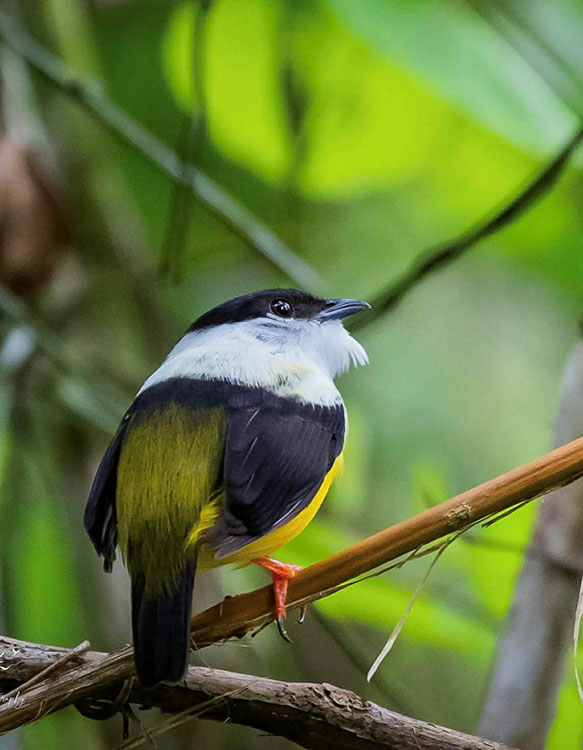
White-collared Manakin male (Manacus candei) at Finca Luna Nueva Lodge. Photo: Alberto Palma.
Walk the secondary forest edges at Finca Luna Nueva in the morning — particularly in the slip of secondary forest nestled between the pasture and the food forest — and sooner or later you will hear it: a sharp, explosive snap, like a tiny twig breaking under boot. Then another. Then a rapid percussion of them, overlapping and urgent. You are hearing the sound of evolution performing itself in real time.
The White-collared Manakin (Manacus candei) is one of the Caribbean slope's great avian treasures.21 The male is a crisp little study in contrast: black crown, black wings, white throat and chest flaring into a beard that he erects during display, olive rump, yellow belly. The female is demure olive-green. But it is what the male does that stops every visitor cold.
The White-collared Manakin is a lek-displaying species — one of the most captivating of all avian behavioral strategies. Each male clears a patch of forest floor up to 120 centimeters across, down to bare earth, then claims two or three thin upright saplings as his court. He then spends his days leaping between those sticks with extraordinary speed, snapping his heavily modified wing feathers to produce that cracking sound — each snap an advertisement to every female within earshot.21 When a female visits, two males may display together, jumping and crossing above the bare court in a coordinated performance of almost comic intensity, throat feathers erected into full beard.
What makes Finca Luna Nueva exceptional is that it hosts multiple established leks — not one solitary male making the best of marginal habitat, but a genuine community of displaying males competing across multiple courts. This is significant: leks form in areas where males have chosen to concentrate because the habitat is right. The species inhabits thickets at moist forest edges, tall secondary growth, and — notably — old cacao plantations.21 Finca Luna Nueva's organic cacao groves, secondary growth corridors, and protected forest edges provide exactly this mosaic. The leks are not accidental. They are a verdict.
The White-collared Manakin is also a geographic indicator species: it is the Caribbean-slope representative of the Manacus genus, replaced on the Pacific slope by the Orange-collared Manakin — a divergence driven by the Cordillera de Talamanca acting as a biological barrier over millennia.22 Seeing it at Finca Luna Nueva tells you unambiguously that you are in the right place, in the right habitat, on the right side of the mountains.
SPECIES SPOTLIGHT:
White-collared Manakin (Manacus candei)
- ResidentBest locations: Secondary forest edges along the main trail to the Cabalonga Trail and Bamboo Observation Tower
Best time: Active at leks year-round; peak display activity in breeding season (roughly February–July)
What to listen for: Explosive wing-snap, rapid crackling percussion from the lek; often heard before seen
The Broad-billed Motmot: A Living Pendulum
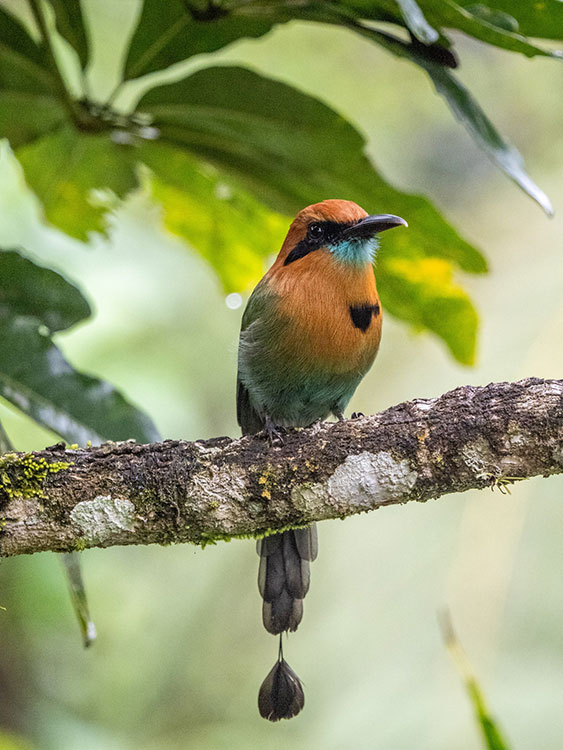
Broad-billed Motmot (Electron platyrhynchum), Finca Luna Nueva Lodge — Photo: Tom Newmark
The motmots are, as one Costa Rican legend puts it, the birds who hid while everyone else worked — and were punished for eternity with a shortened tail. Whether or not you believe the Bribri story, the Broad-billed Motmot (Electron platyrhynchum) would be a worthy subject for any mythology. It is one of the most visually arresting birds in the Neotropics.
At about 30 centimeters long and weighing around 60 grams, the Broad-billed Motmot (Electron platyrhynchum) is a compact, stunning bird: cinnamon-rufous on the head and breast, a vivid turquoise chin patch, green across the back and belly shading to teal on the flanks, with a broad flattened bill, a black mask, and a distinctive black chest spot.24 Its most celebrated feature is the elongated central tail, which ends in two bare-shafted, spatula-tipped rackets — feathers whose weakly attached barbs naturally fall away during preening, leaving the racket shape that gives the family its fame. The bird's habit of wagging this tail slowly from side to side like a pendulum has earned motmots the Spanish nickname bobo — roughly "silly bird" — and the sobriquet clock bird.
On the Caribbean slope, the Broad-billed Motmot is a regular presence wherever there is forest, tall second growth, and embankments for nesting.25 It is a sedentary, non-migratory bird of forest edges and riparian zones — exactly the habitat matrix that Finca Luna Nueva maintains throughout its property. The Chachagua River corridor and the forested ravines on the property provide ideal motmot nesting habitat: the species nests in earthen burrows, and the lodge's maintained streamside vegetation gives it precisely the embankment structure it requires.
The Broad-billed Motmot hunts with extraordinary patience — a wait-and-watch predator that sits motionless on a mid-story branch scanning its surroundings, then executes what ornithologists call a sally-strike to snatch a large insect, small frog, or lizard before returning to its perch.24 On a property free of pesticides, with invertebrate populations intact, this hunting strategy pays dividends. Birders most reliably find motmots at dawn and dusk, often in the riparian zones or along trail edges. Listen for the low, resonant mot-mot call — the bird named itself.
SPECIES SPOTLIGHT:
Broad-billed Motmot (Electron platyrhynchum)
- ResidentBest locations: Riparian zones, forest trail edges, Chachagua River corridor
Best time: Dawn and dusk year-round
What to listen for: Low, resonant "mot-mot" or "bo-bo" call; one of the most recognizable sounds of the Caribbean slope
The King Vulture: Royalty on the Thermal
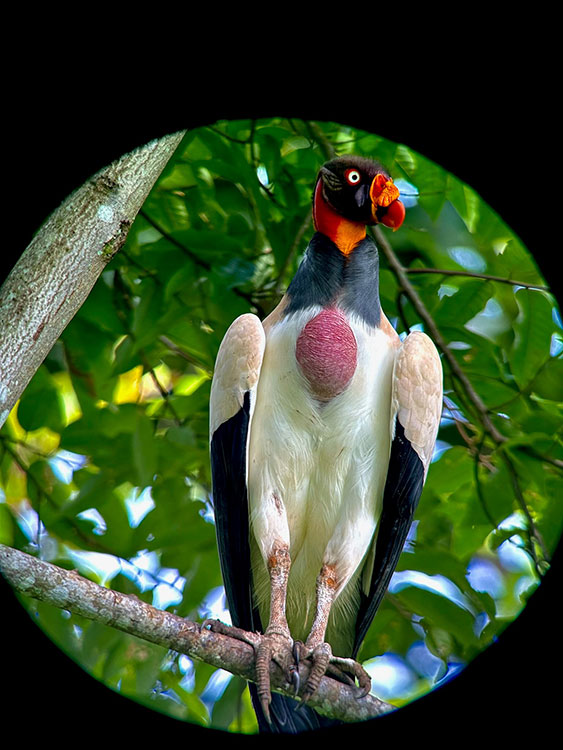
King Vulture (Sarcoramphus papa), Finca Luna Nueva Lodge — Photo: Tom Newmark
Soar over Finca Luna Nueva on a warm midday and, if you are very lucky, you will see a massive black-and-white bird riding a thermal — wings flat and broad, with none of the characteristic dihedral tilt of the Turkey or Black Vulture. That is the King Vulture (Sarcoramphus papa), and its appearance above the lodge is one of those birding moments that simply stops conversation.
The King Vulture is spectacular by any measure. Adults are mostly white with black tail and wingtips, but it is the bare head and neck — a gaudy arrangement of orange, red, yellow, and purple, crowned with a fleshy orange caruncle — that makes the bird unmistakable.26 In ancient Maya mythology, King Vultures were seen as intermediaries between the human world and the gods, and standing beneath one in flight, watching those two-meter wings cut silently across a blue sky, it is not difficult to understand why. One of Costa Rica’s finest architects, the late and greatly missed Rolf Ruge, once described vultures as the most sacred of all birds — because “they take our [stuff] to heaven.” It’s an exalted ride to heaven on the wings of the King!
The King Vulture's presence over a property is an indicator of one thing above all: large, intact, protected forest nearby. The species depends on lowland tropical forest for food and nesting, and is directly threatened by deforestation and habitat fragmentation.26 It is rarely seen over degraded agricultural land. Its regularity above Finca Luna Nueva — soaring from thermals generated over the farm, detectable from the property's elevated observation platforms — speaks directly to the quality and extent of the connected forest reserve.
Unlike Turkey and Black Vultures, the King Vulture does not locate food primarily by smell — it watches where other vultures gather, then descends to take precedence at carcasses, its powerful bill able to open flesh that smaller vultures cannot access. A hide at the lodge at the edge of the primary rainforest has begun attracting local King Vultures, offering photographers the rare opportunity to get close-range images of this otherwise high-soaring species.27
SPECIES SPOTLIGHT:
King Vulture (Sarcoramphus papa)
- ResidentBest locations: Riparian zones, forest trail edges, Chachagua River corridor
Best time: Dawn and dusk year-round
What to listen for: Low, resonant "mot-mot" or "bo-bo" call; one of the most recognizable sounds of the Caribbean slope
The Green Ibis: A Voice from the Water’s Edge
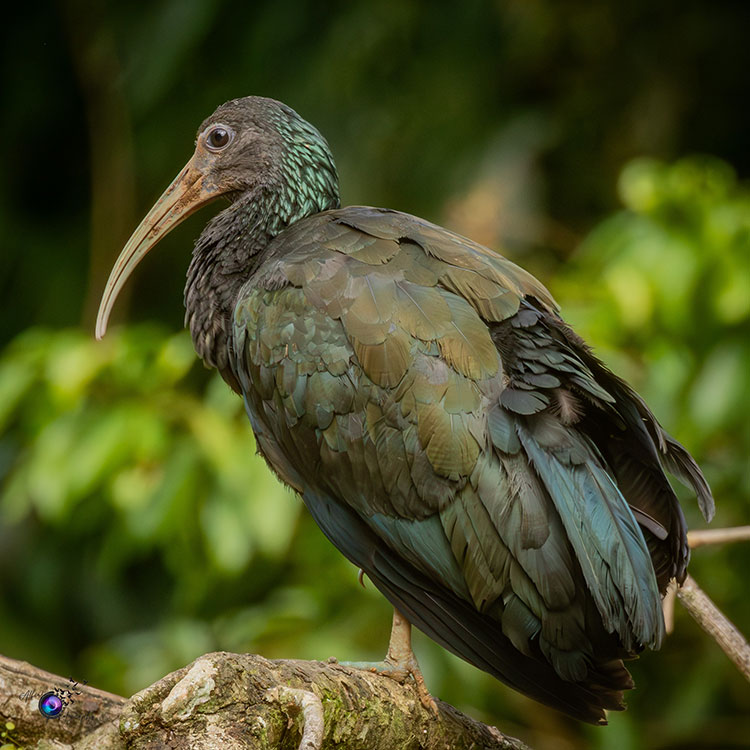
Green Ibis (Mesembrinibis cayennensis), Caño Negro, Costa Rica — Photo: Alberto Palma
Most visitors to Finca Luna Nueva encounter the Green Ibis (Mesembrinibis cayennensis) first by sound: an otherworldly, descending call — imagine a baritone slide whistle from the sound stage of Star Wars — rolling through the forest canopy with an authority that stops you mid-step. Unmistakable once you know it, and easy to confuse with nothing else once you’ve heard it. As a crepuscular bird, the Green Ibis is most active at dusk and dawn, so early risers and late-afternoon walkers have the best odds of an encounter. Guests have spotted it near the pond by the lodge entrance, along a stream on the Rainforest Mysteries Trail, and flying toward a pond near the dairy. When the bird finally appears — large, dark, glossy, with that long downcurved ibis bill — the effect is one of sudden recognition: this is not a common bird.
The Green Ibis is a species of forested ponds, streams, and wetland edges in the Caribbean lowlands, where it forages in shallow water and along muddy banks for invertebrates, small fish, and amphibians.27 It is not a bird that tolerates degraded habitat. Its presence at multiple points across the property — the entrance pond, the Rainforest Mysteries Trail stream, the dairy pond — is a direct measure of wetland and riparian habitat quality across the whole farm.
Relatively few birding lodges in the Arenal region can reliably report Green Ibis. Its appearance on the lodge's eBird list is another data point in the same argument made by the King Vulture: that Finca Luna Nueva's forest and riparian habitats are functioning at a level that rewards the most demanding species.
SPECIES SPOTLIGHT:
Green Ibis (Mesembrinibis cayennensis)
- ResidentBest locations: Entrance pond, Rainforest Mysteries Trail stream, dairy pond
Best time: Dawn and dusk (crepuscular); resident year-round
What to listen for: Loud descending calls; more easily heard than seen
The Scarlet Macaw Flock: A Ten-Year Conservation Story
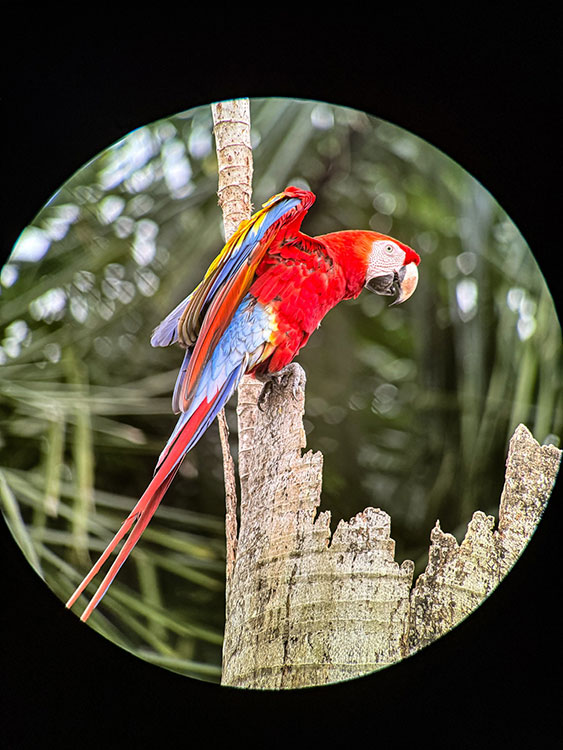
Scarlet Macaw (Ara macao), Finca Luna Nueva Lodge — Photo: Tom Newmark
There are birds that appear on a property, are noted, and leave. And then there is what has happened at Finca Luna Nueva with the Scarlet Macaw.
For nearly a decade, a resident flock of Scarlet Macaws (Ara macao) has chosen a particular part of the Finca Luna Nueva property for regular roosting. They arrive reliably — their arrival announced by a rolling, raucous cacophony long before the first flash of red, yellow, and blue clears the treetops. They are not occasional visitors. They are residents, and their decade-long fidelity to this site is among the most remarkable conservation stories in the Arenal region.
Over the past decade, Scarlet Macaw populations have expanded significantly along the Caribbean slope of Costa Rica — a recovery driven by forest protection, reduced poaching, and connectivity between intact habitat patches.27 Finca Luna Nueva’s position at the edge of the Children’s Eternal Rainforest corridor, its pesticide-free management, and the fruiting trees maintained throughout the property made it attractive habitat. The macaws found it, settled in, and have returned year after year. We joke, in the spirit of the movie Casablanca, that “of all the gin joints in all the towns in all the world,” the Scarlet Macaws chose to live here. We’re so proud of that!
Driving in to the lodge, guests may witness nesting macaws in old palm trees near the entrance. Guests have seen these spectacular birds flying over the farm en route to their roosting site near the dairy. Upon arrival, these flying crimson dinosaurs seem to be loudly discussing their day’s experiences, and they often squabble over who gets to roost on which branch of the pine trees near Casita Esplendor. Speaking of Casita Esplendor, guests in that dwelling have front-row seats to the coming and going of these birds, which is a treasure. But it’s also an effective alarm clock, as the birds often boisterously plan their day before taking off at around 5:15 a.m. Few birding experiences available anywhere in Costa Rica equal the sight of Scarlet Macaws in daily residence, apparently unbothered by your presence.
This flock is a living measure of how far the Caribbean slope’s macaw population has come — and of what Finca Luna Nueva’s conservation commitments, over nearly three decades, have made possible.
SPECIES SPOTLIGHT:
Scarlet Macaw (Ara macao)
- Established Resident FlockStatus: Resident flock roosting at the property for approximately 10 years
Best locations: Fruiting trees throughout the property; visible on the drive in
Best time: Year-round; most active morning and late afternoon
Field marks: Unmistakable — brilliant scarlet body, blue and yellow wings, long streaming tail
What 364 Species Actually Looks Like
Numbers on a page are one thing. Let's talk about what a day of birding at Finca Luna Nueva actually delivers.
Dawn begins before the light reaches the valley. The first sounds are often the deep, resonant call of a Great Curassow from the forest — a species that, as birding expert Patrick O'Donnell noted after his visit, you are "almost certain to encounter" on the deep rainforest Cabalonga Trail. Great Curassows are now regularly encountered along the trail up to the bamboo observation tower and the primary rainforest. In recent years, the grounds were home to a morph barred female, but of late we haven’t seen that striped curiosity. Birders, she’s probably out there waiting to be rediscovered!7 The Curassow is an indicator species: it tolerates no degraded habitat, no pesticides, no edge stress. Its presence is a direct verdict on the quality of the primary forest.
Then the crack of a manakin lek breaks through the understory. Then the deep, resonant mot-mot of a Broad-billed Motmot from the river corridor. Then, if you are scanning the clearing sky above the canopy, that flat-winged silhouette of a King Vulture catching the first thermal. By the time full light arrives, the morning is already dense with sightings.
The canopy tower delivers a different register: Collared Aracaris, Keel-billed Toucans, Yellow-throated Toucans, multiple trogon species, and Montezuma Oropendolas moving through the crowns. Euphonias, honeycreepers, and tanagers work mixed feeding flocks. A Scarlet Macaw rockets overhead, calling continuously, its red trailing against the green.
Mid-morning, the gardens produce the hummingbird parade. Twenty species recorded in the region around the lodge — with the Black-crested Coquette as the standout prize, and the White-necked Jacobin spotted feeding near the reception on the Ojo de Buey (Ox Eye) vines that droop over the parking area — work the native plantings the lodge has curated over decades. The morning soundtrack is often a mix of the croaking Keel-billed and the variegated barks of the Yellow-throated, resulting in a riot of rainforest raucousness.
Afternoon brings the forest interior: mixed species flocks moving through secondary growth into primary forest — antwrens, antbirds, woodcreepers, foliage-gleaners — all moving through the canopy in the loose cooperative that amplifies each individual’s foraging efficiency.
Through the night and into the early morning, the deep murmuring bass of the Spectacled Owl rumbles through the forest — one of the most elemental sounds in the Neotropics, and a reminder that even after the macaws have gone to roost, Finca Luna Nueva’s avian day is never truly over.
A 10,000 Birds team identified 114 species in just two days20 — and that was before the Scarlet Macaw flock established itself, before the manakin leks were as well documented, before nearly another decade of careful habitat stewardship had further enriched the property's avian community. The full 364-species eBird list — built by naturalist Royvin Gutierrez, birding specialist Alberto Palma, and visiting experts including Juan Diego Vargas and Mirna Salas6 — is not a list assembled by accident. It is the record of a landscape deliberately, scientifically managed for maximum ecological complexity. That record is also situated within the Arenal Volcano region — one of the richest birding landscapes in all of Central America, where more than 450 species have been recorded across the broader area. Finca Luna Nueva sits at the heart of this region, and visiting birders can combine on-property birding with day excursions in every direction to access additional ecosystems and hundreds more species.
When to Come: A Birder's Calendar for Finca Luna Nueva
Finca Luna Nueva is exceptional because it rewards visitors in every season — but different seasons deliver different experiences, and understanding the rhythm of migration and residency dramatically sharpens your planning.
September–November: The Migration Corridor Opens
Of all the spectacles available to birders on the Caribbean slope, the autumn raptor migration may be the most underappreciated by visitors who time their trips by the dry season alone. Costa Rica's Caribbean slope is physically trapped between the Caribbean coastline and the Talamanca mountains — a geographic bottleneck that funnels millions of migrating birds over this narrow corridor each fall.30 Raptors, hawks, swallows, warblers, flycatchers, vireos, tanagers, and shorebirds pour south through the Arenal-Caribbean slope region in waves.
The mass influx of long-distance migrants from North America typically begins in late August and peaks through September and October, with some species continuing through November.28 During this window, Finca Luna Nueva's trails and skies become temporarily populated by familiar faces from the north. Broad-winged Hawks and Swainson's Hawks kettle overhead in their thousands. Tennessee Warblers, Chestnut-sided Warblers, and Bay-breasted Warblers work the canopy alongside the resident tanagers. Peregrine Falcons cut through, hunting swallows above the gardens. October, in particular, is peak time: one experienced local birder described it as the moment when "a river of raptors is flowing through the Caribbean lowlands."29
For visitors from North America, there is a particular pleasure in September–October birding at Finca Luna Nueva: warblers and flycatchers you know from home, moving through the same forest as species you've never seen in your life. A Bay-breasted Warbler in a mixed flock with a Crimson-collared Tanager. An Eastern Wood-Pewee on a branch below a Keel-billed Toucan. The hemispheres overlap here, and the overlap is glorious.
September–October also coincides with the lodge’s renowned Caribbean slope harvest season: mangosteens, rambutans, Colombian sapotes, and other rare tropical fruits ripening in the gardens. The same fruiting trees that attract guests to the breakfast table attract frugivorous birds — tanagers, manakins, and toucans — in concentrated numbers. Bird-watching and breakfast become the same activity.
October–March: The Winter Residents Settle In
Once the migration pulse subsides, the winter residents stay. From late October through early March, the lodge hosts its full complement of North American wintering species alongside all the year-round residents.31
This is the period for Summer Tanagers — brilliant red males foraging in the garden plantings. For Baltimore Orioles in the canopy. For the Philadelphia Vireo and a parade of warblers: Wilson's, Black-and-white, Black-throated Green, Yellow, and many others, all in their duller non-breeding plumage but present and active. The birder who dismisses these winter-plumaged warblers is missing a pleasure — there is something satisfying about identifying a Chestnut-sided Warbler in the company of a Rufous-tailed Hummingbird, knowing the warbler's next stop in spring will be the forests of Vermont or Ontario.
The dry-season advantage of December–April is real: clearer mornings, better light for photography, and trails that are navigable without tropical downpours. January through April are peak months for organized birding tours, and the lodge maintains a roster of expert birding guides from which recommendations can be made to suit each guest’s interests and experience.32
March–April: The Northbound Rush
As the dry season ends, the wintering birds begin their departure — but not before southbound migrants from South America begin arriving to breed in Costa Rica. Swallow-tailed Kites appear overhead, arriving from South America. Piratic Flycatchers and Sulphur-bellied Flycatchers set up territories.28 Resident breeders become vocal as the breeding season peaks. March and April are the one time of year when you might hear a wintering warbler attempt a song — an opportunity to hear both hemispheres simultaneously.
Year-Round: The Residents
Whatever the season, the permanent residents anchor the experience. The White-collared Manakin dances at its leks in the secondary growth. The Broad-billed Motmot calls at dawn from the river corridor. The Green Ibis works the ponds and streams of the property. The King Vulture soars on midday thermals. And the Scarlet Macaw flock announces itself over the treetops, noisy and brilliant, as it has done every day for nearly a decade.
The Great Curassow walks the Cabalonga Trail. Hummingbirds — 20 species recorded in the surrounding region, including the spectacular White-necked Jacobin that frequents the garden edges — work the property from first light to last. The farm runs, the cacao grows, the soil builds, and 364 species of birds agree that this place has earned their company.
Planning Your Visit: Practical Notes
Guides and Resources
The lodge maintains a bird checklist developed by Juan Diego Vargas and Mirna Salas,6 regularly updated by naturalist Royvin Gutierrez and birding specialist Alberto Palma. This checklist notes not only species but specific trail locations and seasonal timing. For live community data, the eBird hotspot (L1873352) shows recent sightings in real time.
Infrastructure
The property offers maintained trails through all major habitat types: the deep-forest Cabalonga Trail for interior specialists; the Rainforest Mysteries Trail for mixed-flock following; garden and gallery forest zones for hummingbirds and edge species; and the 35-foot bamboo canopy tower for canopy-level access. A King Vulture photography hide and proximity to the Pocosol Research Station of the Children’s Eternal Rainforest extend the potential list significantly.
Day Trips: Three World-Class Birding Destinations Within Easy Reach
One of the most compelling advantages of staying at Finca Luna Nueva is the access it provides to nearby birding destinations that add entirely different ecosystems to a visitor’s itinerary — cloud forest highlands, primeval wetlands, and deeper primary rainforest, each reachable as a day trip and each adding dozens of species not found on the lodge property itself.
Pocosol Research Station: Bare-necked Umbrellabird at Your Doorstep
The closest of these excursions requires neither a long drive nor a full day. The Pocosol Research Station of the Children’s Eternal Rainforest lies just a short drive from Finca Luna Nueva, at a slightly higher elevation of 720 meters — enough to shift the avian community meaningfully upslope. Pocosol sits within one of the most biodiverse patches of forest on earth: the Children’s Eternal Rainforest, whose 23,000 hectares harbor 450 bird species — roughly half of Costa Rica’s entire avifauna — including several well-known threatened species.
The signature target at Pocosol is the Bare-necked Umbrellabird (Cephalopterus glabricollis) — a large, extraordinary cotinga found primarily in the middle-elevation Caribbean-slope forests of the Tilerán mountain range. The male is unmistakable: jet black with a dramatic erectile crest that spills forward over the bill like a collapsed umbrella, and a long, wattled throat ornament that inflates during display. Research published in Bird Conservation International documented that Umbrellabirds use continuous forest from 400 to 1,850 meters within the Arenal-Monteverde complex — precisely the elevational range spanning Finca Luna Nueva and Pocosol. Birders visiting Pocosol have also encountered the Purplish-backed Quail-Dove, Lanceolated Monklet, Yellow-eared Toucanet, Rufous-vented Ground-Cuckoo, and the rarely seen Sharpbill — species that represent some of the most sought-after targets on the Caribbean slope. Because Pocosol’s station buildings are surrounded by primary forest, significant birding can begin from the balcony before a trail is ever set foot on.
La Paz de San Ramón: The Resplendent Quetzal and Three-wattled Bellbird, 75 Minutes Away
Approximately 75 minutes from the lodge, the cloud forest community of La Paz de San Ramón is home to the Reserva Natural Valle de los Quetzales — a privately managed reserve where nesting Resplendent Quetzals are reliably present during the breeding season. The Quetzal’s nesting season runs from roughly February through June or July, when males display their meter-long tail plumes and both parents share incubation duties at tree-cavity nests, making them far easier to locate than at any other time of year. The San Ramón cloud forest connects directly to the Monteverde reserves, harboring the same high-elevation species in far less crowded conditions.
The reserve also hosts the Three-wattled Bellbird — a Vulnerable species and possessor of one of the loudest and most arresting bird calls on Earth, a resonant, almost mechanical BONG that carries hundreds of meters through the cloud forest. For visitors arriving between February and June, a morning at La Paz de San Ramón adds the cloud forest guild in full breeding display: Quetzal, Bellbird, Emerald Toucanet, Long-tailed Manakin, and approximately 200 other highland species not found at the lodge’s elevation. The drive back to Finca Luna Nueva descends from mist-wreathed oak canopy through mid-elevation forest back to Caribbean-slope rainforest — three ecosystems in a single morning’s travel.
Caño Negro Wildlife Refuge: 400+ Species by Boat, 2.5 Hours Away
Where La Paz de San Ramón takes you up into the clouds, the day trip north to Caño Negro Wildlife Refuge — approximately 2.5 hours from the lodge — takes you into the northern lowland wetlands near the Nicaraguan border and an entirely different world of birds. Caño Negro is a RAMSAR-designated Wetland of International Importance covering nearly 25,000 acres of marshes, lagoons, and tropical lowland forest — widely regarded as one of the most important wetland birding sites in all of Central America, with over 400 resident and migratory species on record.
The signature experience is a guided boat tour along the Río Frío, a slow-moving river winding through forest, marshland, and open lagoon. From the boat, without hiking a single trail, guests regularly encounter the Jabiru — the largest flying bird in Central America, a massive stork standing over four feet tall — alongside the Roseate Spoonbill, shocking pink, sweeping the shallows with that distinctive spatula bill. The broader Caño Negro species list reads like a wetland birder’s fantasy: Wood Storks, Snail Kites, Sungrebe, Agami Heron, Boat-billed Heron, Glossy Ibis, White Ibis, multiple kingfisher species, Anhinga, Black-collared Hawk, and the remarkable Nicaraguan Grackle — a bird whose only Costa Rican habitat is this refuge. Best birding falls between November and April, when dropping water levels concentrate birds around lagoons and mud banks. Finca Luna Nueva guests can arrange a full-day departure, cover the drive north, board a boat on the Río Frío, and return by evening — arriving back to the sound of the Scarlet Macaw flock settling into their roosting trees, with a list that may have added thirty or forty species not found on the lodge property itself.
The three day trips — Pocosol for deep-forest rarities just up the road, La Paz de San Ramón for cloud forest Quetzals and Bellbirds, Caño Negro for lowland wetland spectacle — transform a visit to Finca Luna Nueva from an excellent single-site birding experience into a genuinely comprehensive survey of Costa Rica’s avian diversity. The lodge itself delivers the Caribbean-slope rainforest and farm-forest mosaic. Add the day trips and you have touched four distinct ecosystems — and a life list sparkling with the jewels of the Costa Rican land bridge.
Beyond the List
Finca Luna Nueva is a working farm and living classroom with decades of demonstrated commitment to the proposition that agriculture and ecology can be allies. For birders traveling with non-birding companions, the lodge offers a full day on both sides of the binoculars: an herbal medicine workshop, a farm-to-table harvest and cooking experience, the chance to milk the cows of our holistic dairy, cacao and chocolate tours, and rainforest hikes through one of the most biodiverse private farms in the country.
A Living Classroom
There is a particular kind of satisfaction available at Finca Luna Nueva that distinguishes it from birding a park or a biological station. At a national park, you observe. At Finca Luna Nueva, you understand.
When you watch a White-collared Manakin snap his wings on a lek in the forest near our oldest cacao grove, you are not just checking a box. You are seeing a species that selected this site because the secondary forest edge, the absence of pesticides, and the proximity to primary forest met every criterion a manakin has evolved to demand. When a King Vulture tilts overhead on a midday thermal, you are reading a report on forest connectivity — a species that goes where the intact forest goes, and has apparently decided that Finca Luna Nueva is worth returning to. When the Scarlet Macaw flock erupts from the treetops at dusk, you are witnessing ten years of accumulated trust between a wild species and a landscape managed to deserve it.
The 364-species eBird record is, in the end, not just a number. It is a report card. It tells you that the primary forest is intact enough to support interior specialists. It tells you that the farming is clean enough that insectivores can find food. It tells you that the corridor is functioning, bringing species from one of the largest protected wilderness areas in the hemisphere to the edge of a cacao grove where guests eat breakfast. It tells you that migration is real and visible and breathtaking, that the Caribbean slope still funnels its millions of birds southward each autumn, and that Finca Luna Nueva sits directly in their path.
For the birder who wants to not merely see birds but understand them.
For the birder who wants to understand how an agrarian society can feed both its human inhabitants and supercharge its avian biodiversity, there is perhaps no better classroom than here at Finca Luna Nueva Lodge. We have striven for more than thirty years to farm in harmony with the needs of our ecosystem, and our growing list of avian species affirms that we are indeed replenishing the Earth. The birds are here because the land has earned their confidence: we welcome you to see how regeneration takes flight!
Acknowledgments
The author wishes to express special thanks to Alberto Palma and Royvin Gutierrez, expert birding tour guides based in Costa Rica, for their generous and expert review of this article. Their knowledge of the birds, habitats, and trails of Finca Luna Nueva and the surrounding Arenal region is reflected on every page.
In addition, I’m grateful to Michael Priest Photography for permitting us to use Michael’s Scarlet Macaw photo, which was taken just outside our main entrance.
References & Notes
1. eBird, Cornell Lab of Ornithology. Finca Luna Nueva hotspot (L1873352). Accessed April 2026. https://ebird.org/hotspot/L1873352
2. Asociación Ornitológica de Costa Rica (AOCR). Official bird list, Costa Rican Rare Birds and Records Committee. 948 species as of July 2023.
3. Rainforest Cruises. “Costa Rica Birding Guide.” https://rainforestcruises.com. Accessed April 2026.
5. Finca Luna Nueva Lodge. Tropical Birding tour page. https://fincalunanuevalodge.com/tour/tropical-birding-tour/. Accessed April 2026.
6. Juan Diego Vargas & Mirna Salas. Luna Nueva Bird Checklist. 2019 edition. Available at https://fincalunanuevalodge.com.
7. O’Donnell, Patrick. “Finca Luna Nueva Lodge: Biodynamic, Bird-rich Ecolodge.” 10,000 Birds, January 2015. https://10000birds.com/finca-luna-nueva-lodge-biodynamic-bird-rich-ecolodge.htm. Source of quote: “If Great Curassow interests you, you’re almost certain to encounter some on the deep rainforest Cabalonga Trail.”
8. Connell, J.H. (1978). “Diversity in tropical rain forests and coral reefs.” Science 199: 1302–1310.
9. Wikipedia. “Intermediate disturbance hypothesis.” https://en.wikipedia.org/wiki/Intermediate_disturbance_hypothesis. Accessed April 2026.
10. Yang et al. (2025). “Threshold Responses of Bird Communities to Human Footprint: Testing the Intermediate Disturbance Hypothesis.” Ecology and Evolution 15: e72683. doi:10.1002/ece3.72683. Species richness and diversity peak at intermediate Human Footprint Index levels corresponding to mixed agricultural and semi-natural landscapes.
11. Casas et al. (2020). “The role of fire disturbance on habitat structure and bird communities in South Brazilian Highland Grasslands.” Scientific Reports 10: 19598. Intermediately-disturbed sites harbor higher habitat heterogeneity and plant species richness.
12. ScienceDirect / Biological Conservation (2025). “Protected area edges host more warm-dwelling bird communities than the rest of the landscape.” Biological Conservation 295. Protected area edges support distinctly more diverse bird communities due to habitat heterogeneity.
13. Brawn, J.D., Robinson, S.K., Thompson, F.R. (2001). “The Role of Disturbance in the Ecology and Conservation of Birds.” Annual Review of Ecology and Systematics 32: 251–276. Natural edges enhance both bird community diversity and nesting success.
15. Kirk, D.A. et al. (2020). “Organic farming benefits birds most in regions with more intensive agriculture.” Journal of Applied Ecology 57: 1281–1292. Organic farming had the most positive effect on bird abundance in the region with the most intensive agriculture.
16. ScienceDirect / Agriculture, Ecosystems & Environment (2025). “Is regenerative agriculture for the birds? Outcomes are practice and species specific.” Agriculture, Ecosystems & Environment. Regenerative agriculture practices offer approaches to increase bird abundance in farmland contributing to a landscape-scale approach to bird conservation.
17. Organic Farming Research Foundation. “Farming for the Birds.” https://ofrf.org/news/avian-biodiversity-research-summary/. Accessed April 2026. Farms integrating natural habitat supported higher densities of native bird species.
20. O’Donnell, Patrick. “Finca Luna Nueva Lodge: Biodynamic, Bird-rich Ecolodge.” 10,000 Birds, January 2015. https://10000birds.com/finca-luna-nueva-lodge-biodynamic-bird-rich-ecolodge.htm. 114 species recorded in two days; 2014 Arenal Bird Count.
21. Wikipedia. “White-collared Manakin (Manacus candei).” https://en.wikipedia.org/wiki/White-collared_manakin. Accessed April 2026. Lek behavior: each male clears up to 120 cm across to bare earth; leaps between sticks giving a loud wing snap.
22. Wikipedia. “List of birds of Costa Rica.” White-collared manakin noted as Caribbean-slope endemic, distinct from Pacific slope orange-collared manakin. Accessed April 2026.
24. Wikipedia. “Broad-billed Motmot (Electron platyrhynchum).” https://en.wikipedia.org/wiki/Broad-billed_motmot. Length ~30 cm; weight ~60 g. Sedentary resident of humid forest and older second growth. Nests in earthen burrows. Hunts via sally-strike method.
25. Costa Rica Living and Birding. “Where to see Motmots when Birding Costa Rica.” birdingcraft.com. Caribbean slope: Broad-billed Motmot is a regular bird wherever there is forest and embankments for nesting; favors riparian zones.
26. Costa Rica Focus. “King Vulture.” https://costaricafocus.com/bird-species/king-vulture/. Accessed April 2026. Globally facing declines in some areas due to deforestation and habitat fragmentation.
27. Costa Rica Living and Birding (https://birdingcraft.com). Caribbean slope trip notes and Arenal Count 2024 post. King Vulture, Green Ibis, and Scarlet Macaw flock mentioned at Finca Luna Nueva.
28. Aratinga Tours. “Migratory Birds in Costa Rica.” https://aratinga-tours.com/migratory-birds-in-costa-rica/. The mass influx of long-distance migrants from temperate and boreal North America starts around late August.
29. Visit Costa Rica (ICT). “On the Wing.” https://visitcostarica.com/things-to-do/greatest-wildlife-spectacles/on-the-wing. Migration funneled over Caribbean slope; September–October peak; millions of raptors and passerines.
30. Camino Travel / Tico Times. “4 Things Not to Miss During Bird Migration Season.” Millions of raptors funneled over the Caribbean slope during migration season, caught between the coastline and the Talamanca mountains.
31. Costa Rica Living and Birding. “Reminders of Bird Migration in Costa Rica.” https://birdingcraft.com, September 2025. Winter residents October–March: Summer Tanagers, orioles, Philadelphia Vireos, parade of warblers.
32. Birding Ecotours. “When is the best time for birding in Costa Rica?” https://birdingecotours.com. Accessed April 2026. January–April dry season peak for both resident and migratory species.
33. ACMCR / Children’s Eternal Rainforest. “Pocosol Station.” https://acmcr.org/en/pocosol/. Elevation: 720 m on the Caribbean slope. Also: Costa Rica Living and Birding. “Recent Birding at the Pocosol Station.” birdingcraft.com, September 2019. Pocosol described as “one of the better places to connect with Bare-necked Umbrellabird.”
34. Chaves-Campos, J. & Arevalo, J.E. (2003). “Altitudinal movements and conservation of Bare-necked Umbrellabird of the Tilerán Mountains, Costa Rica.” Bird Conservation International 13: 45–58. Continuous forest 400–1,850 m within Arenal–Monteverde complex. Also: Wikipedia. “Children’s Eternal Rainforest.” https://en.wikipedia.org/wiki/Children%27s_Eternal_Rainforest 450 bird species documented.
35. Finca Luna Nueva Lodge. “Quetzals in the Cloudforest.” https://fincalunanuevalodge.com/off-site-tours/quetzals-in-the-cloudforest/. Reserva Natural Valle de los Quetzales, La Paz de San Ramón. Also: Explore Tikizia. “Resplendent Quetzal in San Ramon, Costa Rica.” https://exploretikizia.com. Nesting season February–June/July. Three-wattled Bellbird also present in the same reserve.
36. Birding for Conservation. “Caño Negro Wildlife Refuge: Birding Paradise.” birdingforconservation.com. 400+ species; 200+ observed in four days. Also: Caño Negro Lodge birdwatching page; https://CostaRicaInfoLink.com.
37. Costa Rica Living and Birding. “Arenal Count 2024” and Christmas Counts category. https://birdingcraft.com. Finca Luna Nueva described as count base and primary survey route for the Arenal Christmas Bird Count; 150 species recorded in single count day. Also: Audubon Society. “Christmas Bird Count.” https://audubon.org/community-science/christmas-bird-count.
