


MEET OUR SISTER SPECIES · No. 2
The Sloth’s Secret Garden
March 30, 2026
Posted by: Tom Newmark
Brown-Throated Three-Toed Sloth: Bradypus variegatus
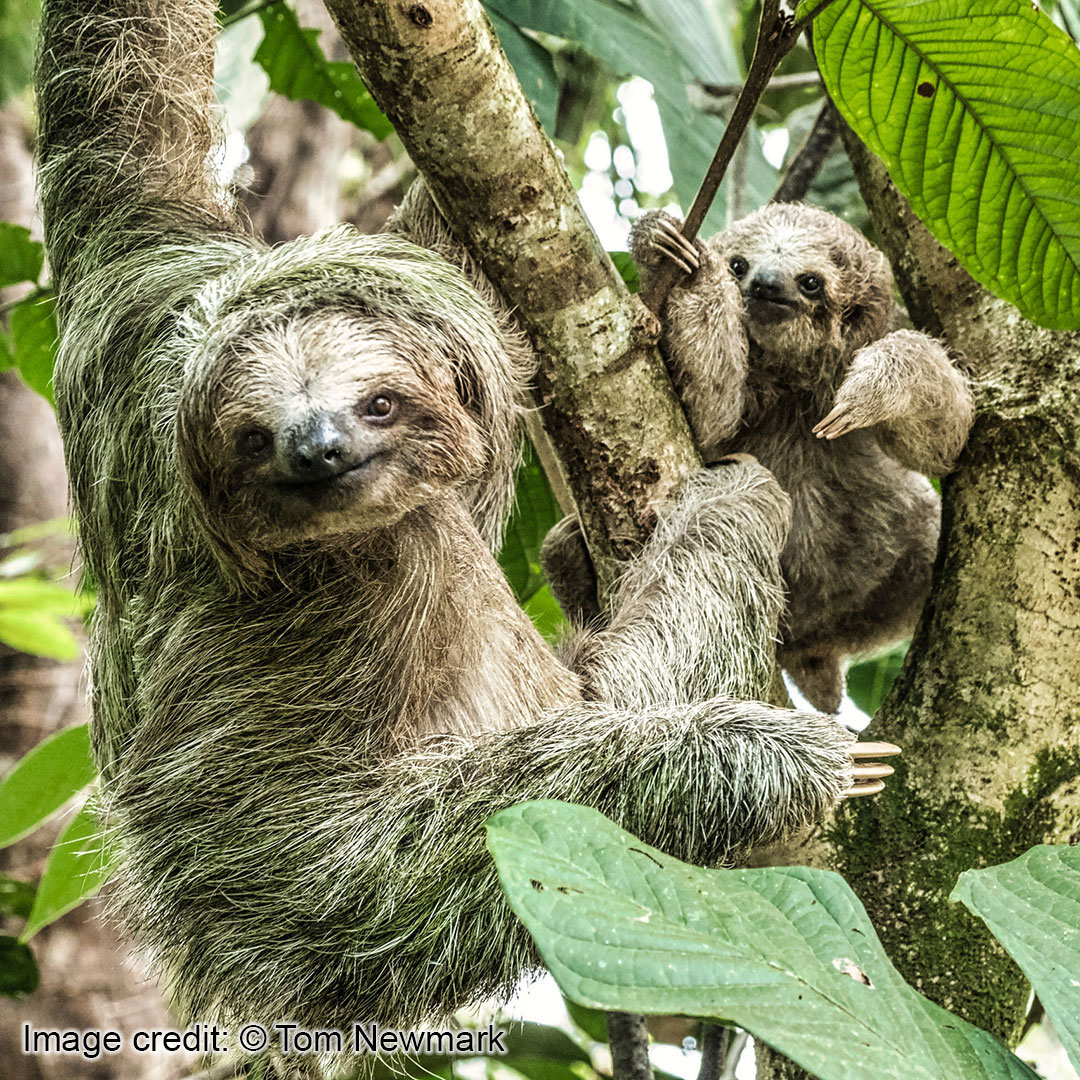
Brown-throated three-toed sloth ( Bradypus variegatus ) — Finca Luna Nueva Lodge, Costa Rica · Photo: Tom Newmark
She wasn’t sleeping. That’s the first thing to understand about sloths — and the first thing most people get wrong. The mother three-toed sloth hanging in the trees across from our reception area was, in fact, working. Teaching. She was showing her baby how the world works, one slow-motion branch at a time.
She’s been in her territory here near the reception for years, possibly decades. We don’t know exactly when she first claimed these trees. But she knows every branch, every leaf, every safe limb. And now she was passing all of that knowledge to the small, wide-eyed creature clinging beside her, learning the geography of survival in the Peñas Blancas Valley of Costa Rica.
There is something about watching a sloth mother and her baby that stops time. Maybe it’s the tenderness. Maybe it’s the paradox — a creature that moves in slow motion navigating a world that never stops accelerating. Whatever the reason, our guests routinely say that spotting a sloth at Finca Luna Nueva is the highlight of their stay. Not the scarlet macaws. Not the toucans. The sloth.
After watching this pair for a while, I started thinking about everything going on beneath that shaggy, greenish fur. What I found — in decades of science and one landmark 2014 study in particular — is one of the most elegant ecological stories I’ve ever come across.
Quick Facts:
Brown-Throated Three-Toed Sloth
| Scientific name: | Bradypus variegatus |
| Family: | Bradypodidae |
| Length: | 45–60 cm (18–24 in) |
| Weight: | 3.5–4.5 kg |
| Lifespan: | 30–40 years in the wild |
| Range: | Honduras to northern Argentina; both slopes of Costa Rica |
| Habitat: | Tropical and subtropical forest; forest edge; secondary growth |
| Diet: | Leaves (primary); algae cultivated in own fur (supplemental) |
| Speed: | Up to 40 meters per hour — the slowest mammal on Earth |
| Sleep: | 15–18 hours per day |
| Status: | Least Concern (IUCN) — locally common in suitable habitat |
A Walking Ecosystem
Here is the thing about sloth fur: it is not just fur.
Look closely at a sloth’s coat and you’ll see the greenish tinge. That’s not a trick of the light. That’s a living garden. Sloth hairs are structurally unique — riddled with tiny microcracks that trap moisture and create the ideal microhabitat for algae, fungi, bacteria, and a remarkable cast of invertebrates. One species of green algae, Trichophilus welckeri, has been found nowhere else on Earth except in sloth fur. The sloth is, in effect, the only habitat this organism has ever known.
And the sloth eats it. Licking the algae from its own fur, the sloth supplements its low-calorie leaf diet with a food source that is, according to researchers, highly digestible and lipid-rich. It’s a garden you wear. An edible coat. Mother Nature’s most eccentric nutrition strategy.
Then add the insects. Sloth fur hosts beetles, cockroaches, mites, and — most crucially — moths. Dozens of species of moth live exclusively in sloth fur, their entire evolutionary history bound up with this one improbable host. One study found more than 120 moths living in the fur of a single three-toed sloth. The sloth, moving slowly enough that entire ecosystems can flourish in its coat, has become a mobile rainforest unto itself.
Sloths produce no mammalian musk — the glandular scent that makes so many animals recognizable to predators and humans alike. They smell like the jungle itself, which is precisely the point. This is different from the volatile chemical signals they do emit, which the moths living in their fur use to locate their host from a distance. The sloth is odorless to noses evolved for musk; it is not invisible to the finely tuned chemoreceptors of an insect that has spent millions of years learning to find home.
The Riskiest Trip of the Week
For years, scientists were baffled by one specific sloth behavior: once a week, the three-toed sloth descends from the safety of the canopy to defecate at the base of its tree.
This is not a small thing. More than half of all sloth deaths occur on or near the ground. The trip burns roughly 8% of the sloth’s daily energy budget — a significant expenditure for an animal whose entire existence is organized around conserving energy. Jaguars wait below. Ocelots patrol the understory. Ornate Hawk Eagles watch from above. Tayras — fast, arboreal weasels built for exactly this kind of opportunism — work the middle canopy. The ground is, for a sloth, the most dangerous place on earth.
Dr. Jonathan Pauli of the University of Wisconsin-Madison and his team published what is now a landmark study in the Proceedings of the Royal Society B in 2014, and their answer is extraordinary: the sloth’s weekly descent is an act of ecological gardening. When it reaches the ground, the gravid moths living in its fur seize their moment — slipping out to lay eggs in the fresh dung. Larvae hatch, develop, then emerge as adults and fly back up into the canopy to find a sloth by scent. When those moths die in the fur, decomposers convert them into nitrogen — the precise fertilizer the algae need to flourish. More moths, more nitrogen; more nitrogen, more algae; more algae, better nutrition and better camouflage.
Birth. Life. Death. Decomposition. Life again. The wheel keeps spinning — and the sloth, by taking that weekly risk on the forest floor, is tending its garden.
The Education of a Sloth
The mother sloth begins teaching immediately. Within the first week of life, her baby is already sampling leaves — not from instinct, but from observation. It eats what she eats, reaching out to pluck foliage directly from around her mouth. Sloth dietary preferences, it turns out, are learned, not inherited. The mother is the baby’s first and only cookbook.
For six to nine months, the baby clings to her chest or back, gradually building the grip strength and spatial awareness it will need to navigate the canopy alone. All the while, the mother is slowly, methodically, covering her territory — showing the young sloth which trees are safe, which limbs will hold weight, which corners of the forest feel like home.
Then comes the separation. The mother leaves her baby in the part of her territory most familiar to the young sloth — and then she leaves. Really leaves. Instead of the young dispersing outward to claim new territory, the mother disperses — and bequeaths the family home to her offspring. The baby doesn’t inherit wealth or a name. It inherits trees.
Baby sloths are known to cry out when their mothers leave. The calls echo through the canopy, plaintive and startling from such a quiet animal. The mothers practice what can only be called tough love: they don’t come back.
Brown-Throated Three-Toed Sloths at Finca Luna Nueva Lodge
Finca Luna Nueva sits at approximately 350 meters on the Caribbean slope — humid foothill forest transitioning to montane, precisely the layered canopy habitat that three-toed sloth's favor. We have two sloth species residing on the farm’s 127 acres: the brown-throated three-toed sloth (Bradypus variegatus) and Hoffmann’s two-toed sloth (Choloepus hoffmanni). They share the canopy but are only distantly related — each independently evolved its arboreal lifestyle in one of evolutionary biology’s great examples of convergence.
The mother and baby photographed here are almost certainly long-tenured residents. Three-toed sloths live 30 to 40 years in the wild. Finding them is simple: look up. Wherever there is ripe fruit on the farm, there is a good chance a sloth already knows about it — even if it takes you a moment to spot the stillness in the canopy that is, in fact, a living creature watching you back.
Come and Look Up
Costa Rica is famous for its wildlife. Travel guides will list the species, the parks, the probabilities. But there is a difference between knowing that three-toed sloths exist in Costa Rica and standing under a cecropia tree at Finca Luna Nueva while a mother and baby regard you with expressions of mild, ancient calm — as if they have been here long enough to have seen everything, and you are simply the latest interesting thing to pass through.
Some animals inspire field guides. This one inspires wonder.
Stop. Look up. Give yourself a moment. You came a long way for this, and it is worth every second.

