


MEET OUR SISTER SPECIES · No. 3
The Little Angels of the Forest
April 6, 2026
Posted by: Tom Newmark
Mariola Bee: Tetragonisca angustula
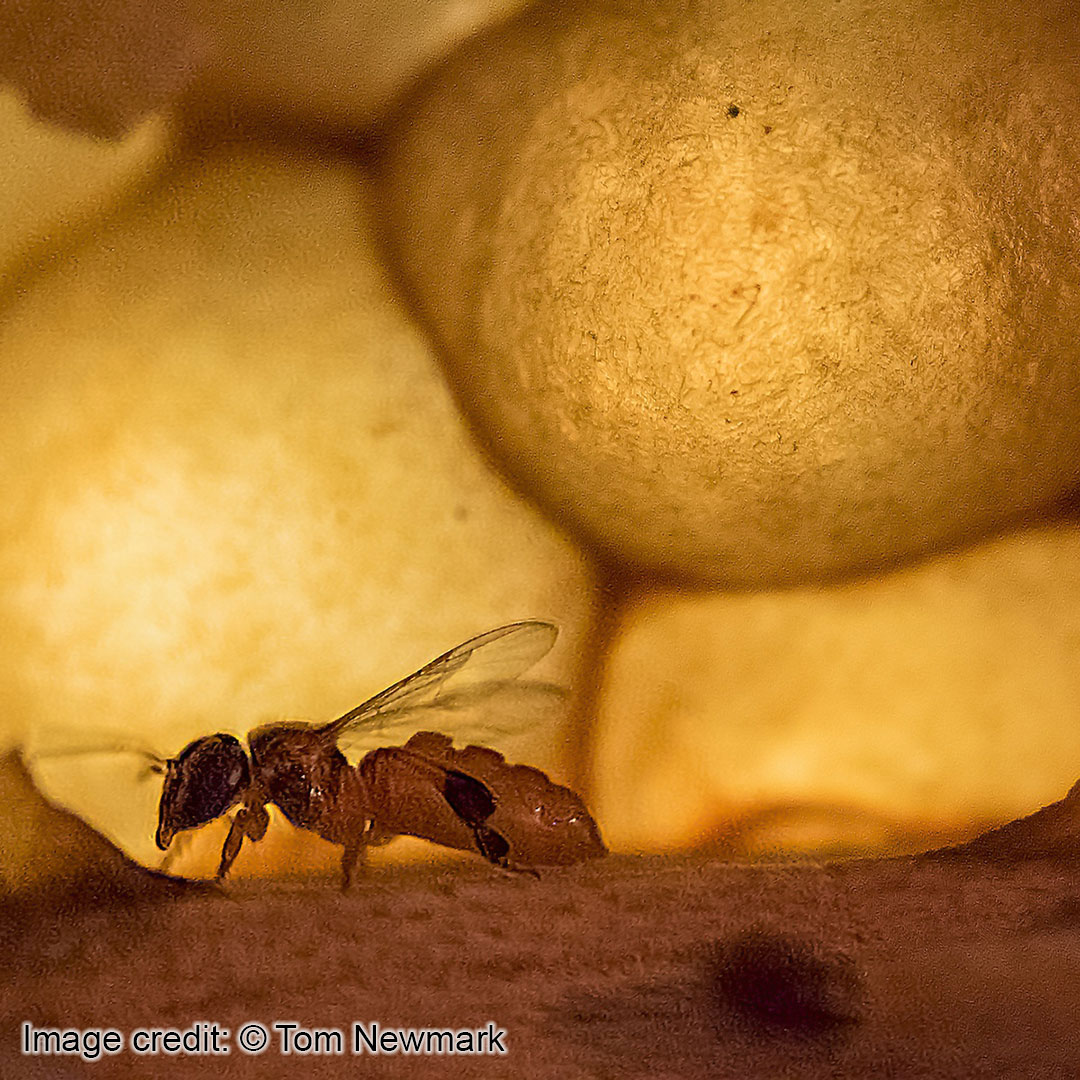
Mariola bee ( Tetragonisca angustula ) amid the Byzantine honeypots of her hive — Finca Luna Nueva Lodge, Costa Rica · Photo: Tom Newmark
She is four millimeters long. You could lose her in a thumbnail. And yet, in the wall of our breakfast room at Finca Luna Nueva, a colony of mariola bees has been living quietly for more than a decade — building, foraging, healing, humming — while Terry and I have our coffee and watch the valley wake up.
We’ve never once considered evicting them. Why would we? They’re stingless. They’re peaceful. And in the wall, sealed in those golden domes of wax and resin, they’re making what may be the most medicinally powerful honey on Earth.
That’s not marketing language. That’s what the science is beginning to confirm — and what the people of Costa Rica have known for a very long time.
Quick Facts:
Mariola Bee
| Scientific name: | Tetragonisca angustula |
| Family: | Apidae (tribe Meliponini — stingless bees) |
| Size: | Approximately 4 mm — one of the smallest bees in Costa Rica |
| Range: | Mexico through Central America and into South America |
| Habitat: | Forest, forest edge, secondary growth, traditional homes and farms |
| Diet: | Nectar and pollen from diverse native flowering plants |
| Honey yield: | Roughly 0.5–1 liter per hive per year |
| Hive architecture: | Byzantine domes; pale gold pots hold honey, russet pots hold pollen |
| Defense: | Stingless; soldier bees latch and bite intruders — harmless to humans |
| Status: | Threatened by deforestation and agrochemical use; ~60 stingless bee species in Costa Rica |
| At FLN: | Approximately 150 active hives across the farm and fields |
The Architecture of the Hive
Open a mariola hive and your first thought is not “bee colony.” It’s cathedral.
Where the European honeybee builds in hexagons — that famous engineering of pure efficiency — the mariola builds in spheres. Domes of honey and pollen packed into cerumen pots, a natural mixture of beeswax and plant resin, stacked like something between a Gaudí chapel and a coral reef. The pale gold domes hold honey. The darker, russet ones hold pollen. Each pot a different chamber in the same living pharmacy.
The photo above was taken by opening one of our hives at the lodge. The tiny bee in the frame is the builder, the forager, the pharmacist. She’s four millimeters of concentrated purpose, caught in the amber light of her own creation.
Honey That Heals
For at least 3,000 years, the indigenous peoples of Mesoamerica — Maya, Aztec, and the pre-Columbian cultures of Central America — kept stingless bees and used their honey as medicine. Not as a sweetener with health benefits. As medicine, full stop.
Traditional uses in Costa Rica include wound care, respiratory infections, and one that stops people mid-sentence: eye treatment. Specifically, pterygium — a corneal growth that can impair vision — has been traditionally treated with diluted mariola honey applied directly to the eye. Modern science has looked at this practice and found it isn’t folklore. Studies with stingless bee honey have shown antimicrobial activity against the pathogens responsible for conjunctivitis equivalent to first-line ocular antibiotics.
The broader antimicrobial picture is even more remarkable. Researchers at the National University of Costa Rica discovered that mariola honey contains proteins capable of dismantling bacterial biofilms — the protective structures that make certain bacteria resistant to conventional antibiotics. This is not a property found in ordinary honey.
Why Mariola, Not Manuka
Manuka honey deserves its reputation. But its medicinal power comes from a single source: methylglyoxal, a compound derived from the nectar of the manuka flower (Leptospermum scoparium) in New Zealand. This means the honey’s potency depends entirely on one plant — and gave beekeepers a powerful economic incentive to do exactly what industrial agriculture always does: reduce diversity, concentrate on the monoculture, maximize the yield of that one compound.
Mariola honey works differently. Its antimicrobial activity comes not from any single flower but from the bees themselves — from the enzymes, proteins, and beneficial microorganisms that the bees and their hive community contribute to the honey. Researchers have identified seven distinct antimicrobial proteins in stingless bee honey, active against bacteria that conventional antibiotics can no longer reliably kill. This activity persists even after heat treatment and does not depend on which flowers the bees visited.
The regenerative implication is profound: the more biodiverse the landscape, the richer the honey. Mariola bees are outstanding pollinators of native flora — their small size allows them to access flowers that larger bees cannot reach. A mariola hive on a regenerative farm is not a tenant. It’s a partner.
The Little Angels at Finca Luna Nueva
We have approximately 150 active mariola hives here at Finca Luna Nueva, distributed across the farm and fields, working the extraordinary floral diversity of the Caribbean slope — from the native trees of our forest edges to the flowers of our regenerative gardens. We think of them as the wild stock of the farm: unmanaged in the industrial sense, simply given good habitat and allowed to do what they’ve done for millions of years.
The honey they produce is citrusy and bright, with a complexity that reflects the diversity of everything they visit. No two harvests taste quite the same. That’s not inconsistency. That’s terroir.
And then there are the ones in our breakfast room wall. They’ve been there for over a decade. Terry and I have our coffee. They have their domes. The honey they make in that wall is antifungal, antimicrobial, and entirely harmless to live alongside. We consider them family.
Come and Meet the Neighbors
In Costa Rica, it has long been considered good luck to have a mariola colony in your home. The Virgin Mary, some say, sent them to protect us — which is where one of their local names comes from: Angelita. Little angel.
Science is still catching up to what Costa Ricans have always understood intuitively: that these four-millimeter creatures, building their golden cathedrals in walls and tree hollows and wooden boxes across this landscape, are doing something extraordinary. They are pollinating the forest. They are healing the sick. They are turning the biodiversity of a regenerative farm into a medicine that no pharmaceutical lab has yet been able to replicate.
Stop. Look up. Give yourself a moment. You came a long way for this, and it is worth every second.

