


MEET OUR SISTER SPECIES · No. 7
Yes, There Are Snakes in the Rainforest
May 4, 2026
Posted by: Tom Newmark
Mica (Tiger Rat Snake): Spilotes pullatus
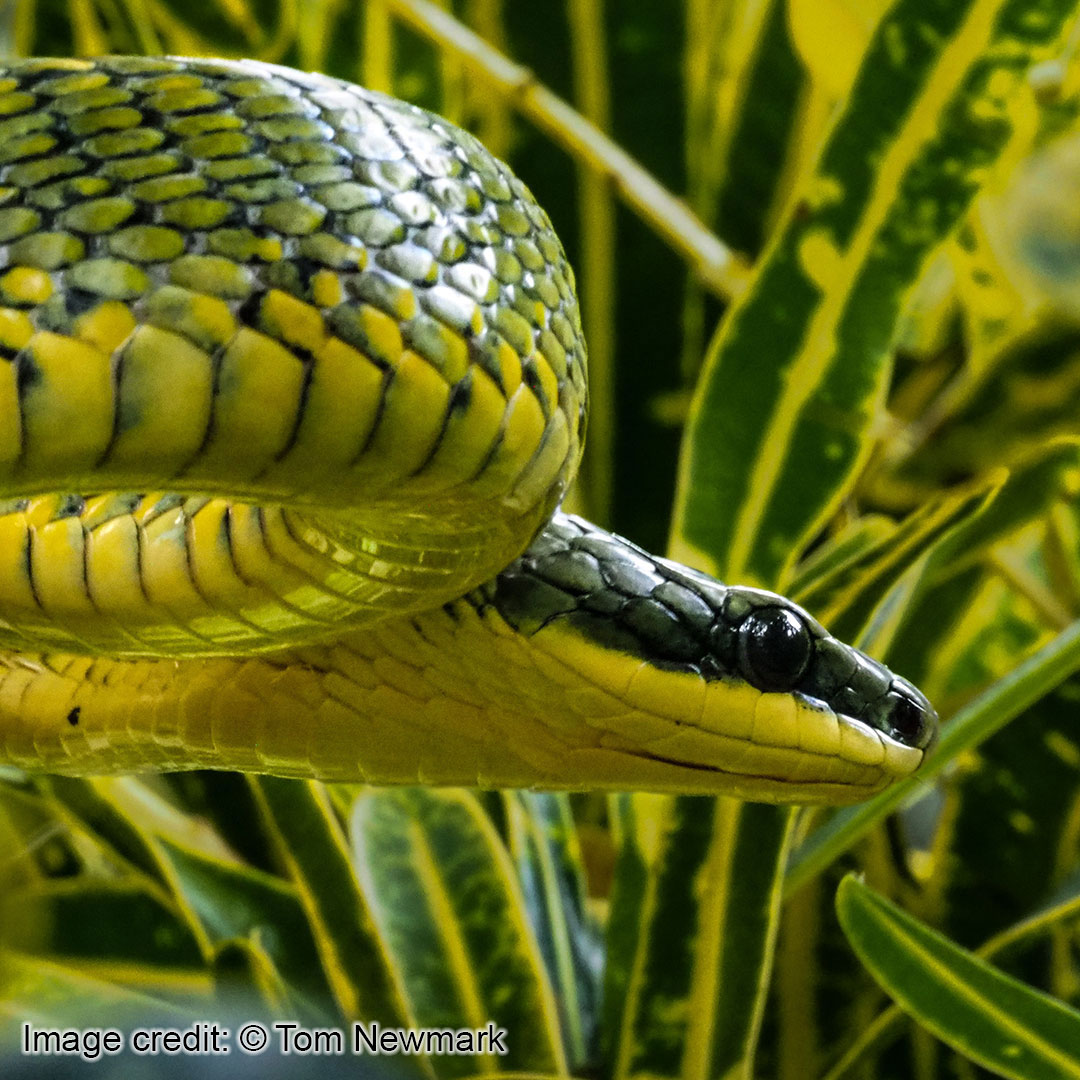
Tiger rat snake (Spilotes pullatus), known locally as the mica — Finca Luna Nueva Lodge, Costa Rica · Photo: Tom Newmark
Yes. There are snakes in the rainforest. We might as well address this directly.
In more than 32 years of living and working on this land — hiking through primary forest, establishing fields, cutting trails, welcoming thousands upon thousands of guests from around the world — not a single person has ever been bitten by a venomous snake at Finca Luna Nueva. Not one. We are not saying it couldn’t happen. We are saying it hasn’t.
For context: I have been bitten twice by genuinely dangerous creatures in my life. Both times, I was in St. Louis, Missouri.
The mica — known in English as the tiger rat snake, Spilotes pullatus — is one of the largest and most visually striking snakes on the Caribbean slope of Costa Rica. It is also nonvenomous, ecologically essential, and entirely welcome on this farm. Whether it returns the sentiment is another question.
Quick Facts:
Mica (Tiger Rat Snake)
| Scientific name: | Spilotes pullatus |
| Family: | Colubridae |
| Local name: | Mica |
| Length: | Up to 2.7 m (nearly 9 ft) — one of the longest snakes in Central America |
| Venom: | None — a constrictor; subdues prey by compression |
| Range: | Southern Mexico through Central America to northern South America |
| Habitat: | Tropical rainforest, forest edge, farms; arboreal and terrestrial |
| Diet: | Rodents, birds, birds’ eggs, bats, lizards |
| Activity: | Diurnal — hunts by day |
| Status: | Least Concern (IUCN) — adaptable to disturbed habitats |
| At FLN: | Resident throughout the farm; frequently near the lodge garden and forest edges |
What You Are Looking At
The photograph above was taken right here at Finca Luna Nueva. Look at the scale pattern: that yellow-and-black geometry, each scale catching the light at a slightly different angle, so the whole animal seems to shift and shimmer as it moves. Against the variegated leaves of the lodge garden, the mica is simultaneously conspicuous and perfectly placed — a reminder that what looks like bold coloration in a photograph is, in context, a surprisingly effective disguise.
That large, glossy black eye is worth noting. The mica is a diurnal hunter with excellent vision. It finds prey by sight and by chemoreception — that flickering tongue sampling the air for molecular information about what has recently passed through. When a mica is looking at you, it is reading you. Filing you away. Deciding, probably correctly, that you are too large to eat and too slow to be a threat.
The Farm’s Rodent Control Department
We almost never see rodents on this farm. For a working tropical farm — surrounded by fruit trees, root vegetables, grain stores, compost, and the general biological abundance of a regenerative operation — that is a remarkable fact. Rats and mice should be everywhere. They are not.
The mica and its colleagues deserve substantial credit for this. A 2.7-meter constrictor that hunts by day, moves through the canopy and across the ground with equal ease, and has a particular fondness for rodents is precisely the pest control system that no agrochemical company has ever been able to replicate. It requires no application schedule, no protective equipment, and no invoice.
The mica is not a problem on this farm. It is a solution.
On Mating, Pheromones, and Questions for Herpetologists
I have watched micas mate — two animals entwined in the slow, deliberate choreography that snakes make of courtship. Others here at the farm have witnessed something stranger and more spectacular: multiple males converging on a single location, moving with unusual urgency, apparently responding to a female’s pheromonal signal. Freshly laid eggs have been found at the center of these gatherings.
The exact dynamics of this behavior — whether it involves competition between males, cooperative guarding, or something else entirely — are not entirely clear to us. If there is a herpetologist reading this who can shed light on what we’ve been seeing, we would genuinely welcome the explanation. The rainforest has a way of presenting phenomena that outpace the available literature.
A Field Tip You Can Actually Use
If you want to find a mica, find a bird’s nest. The tiger rat snake is a documented nest predator — birds’ eggs and nestlings are a preferred target — and when eggs appear in a visible location on the farm, the mica seems to know about it almost immediately. We do not fully understand how. Scent, almost certainly. Observation, possibly. But the correlation is reliable enough that it has become informal field wisdom here: locate a nest, and exercise patience.
Beyond that: walk slowly, look into the canopy, and pay attention to the garden edges where sun and shade meet. The mica moves through both worlds — arboreal and terrestrial — with the easy confidence of an animal that has been doing this for a very long time.
Respect, Not Fear
I am not afraid of this snake. I respect it. There is a difference, and it matters.
Fear would have us clearing the brush, disturbing the habitat, removing an animal that has occupied this ecosystem since long before any human thought to farm here. Respect lets us recognize that the mica has a role — in rodent control, in nest predation, in the food web that connects every living thing on this farm — and that our job is to understand that role well enough not to disrupt it.
I’ll be honest: I’m still working out exactly how we humans fit into this ecosystem. The mica seems to have figured out its part. We’re catching up.
Stop. Look up. Give yourself a moment. You came a long way for this, and it is worth every second.

