


MEET OUR SISTER SPECIES · No. 11
The Scarlet Macaw: A Ten-Year Love Story
June 1, 2026
Posted by: Tom Newmark
Scarlet Macaw: Ara macao
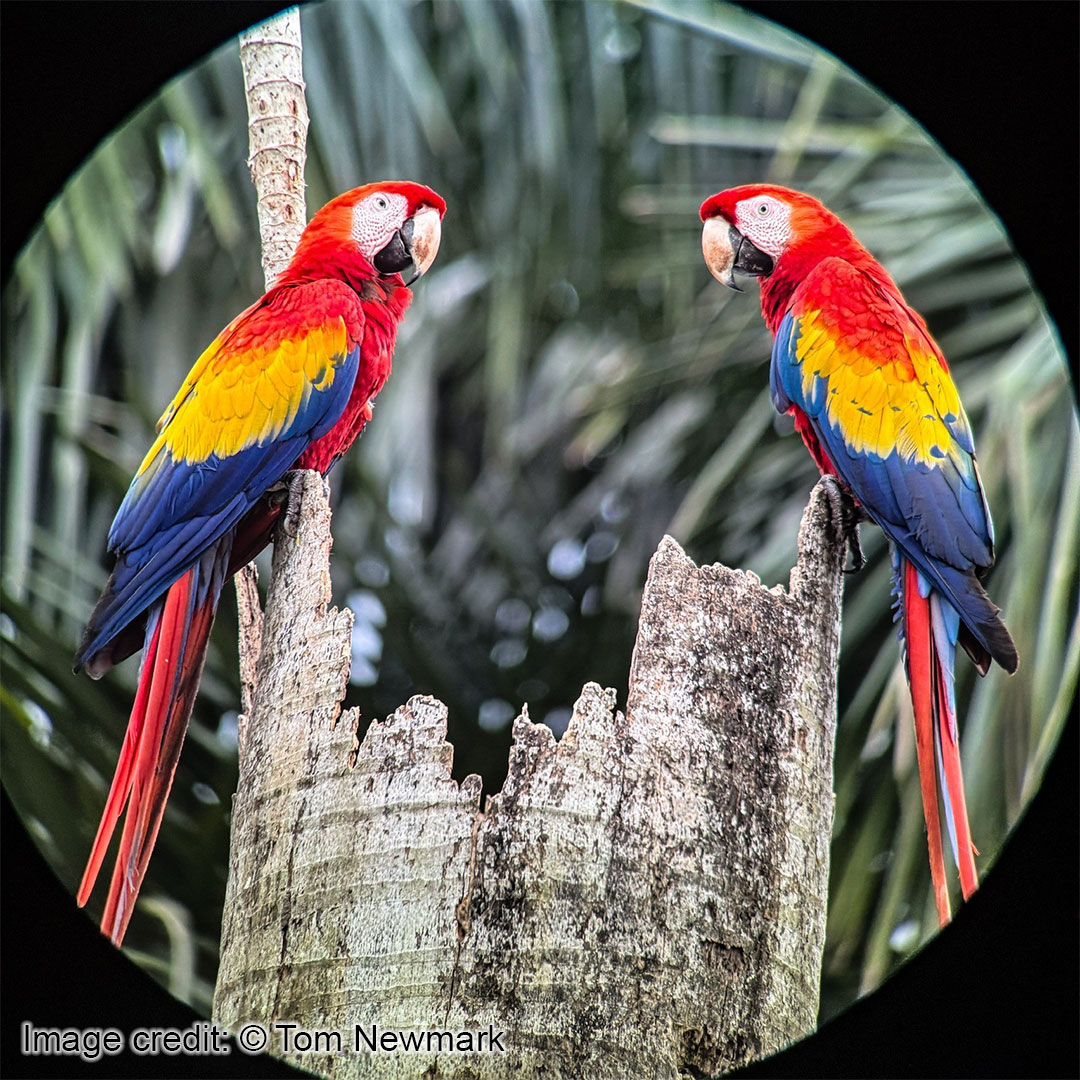
A nesting pair of Scarlet Macaws photographed through a spotting scope near Finca Luna Nueva Lodge · Photo: Tom Newmark
For nearly a decade, a resident flock of approximately thirty Scarlet Macaws — Ara macao — has chosen Finca Luna Nueva for regular roosting. They arrive reliably, their coming announced by a rolling, raucous cacophony long before the first flash of red, yellow, and blue clears the treetops. They are not occasional visitors. They are residents, and their fidelity to this site across nearly a decade is among the most remarkable conservation stories we know of in the Arenal region. We are frankly awed by it.
We joke, in the spirit of the movie Casablanca, that “of all the gin joints in all the towns in all the world,” the Scarlet Macaws chose to fly into ours. We’re so proud of that.
Why This Matters More Than You Might Think
The Scarlet Macaw is, by any measure, one of the most spectacular birds on Earth. Wingspan over a meter. Plumage that burns red, yellow, and cobalt blue against any background. A voice that carries across a valley. And a conservation status in Costa Rica that makes every individual bird precious.
There are approximately 2,000 Scarlet Macaws in Costa Rica — in the entire country — and no more than 4,000 in all of Central America. The species has been extirpated from the vast majority of its former range in Costa Rica, with only two healthy sub-populations remaining. The birds that fly over Finca Luna Nueva every day belong to Ara macao — the same species found from Mexico to the Amazon, glorious throughout its range, and under serious pressure across most of it.
Our flock of approximately thirty birds represents something like 1.5 percent of the entire Costa Rican population. That is not a birding footnote. That is a genuine conservation event, playing out every day above our dairy, our pastures, our Sacred Seed Sanctuary, and the many beach almond trees we have planted over the decades.
The Birds Themselves
The Scarlet Macaw is one of the largest parrots in the world — though in Costa Rica that distinction belongs to the Great Green Macaw (Ara ambigua), a magnificent species that has itself been spotted at Finca Luna Nueva. But that is a story for another day.
Adults reach nearly 85 centimeters from bill to tail tip, with most of that length being the magnificent streaming tail. The plumage is predominantly scarlet, with bright yellow wing coverts, blue flight feathers, and — a detail worth examining closely — no green separating the yellow from the blue, which distinguishes the Central American subspecies from their South American cousins.
They mate for life. A bonded pair will roost together, forage together, and nest in tree cavities — showing strong site fidelity, returning to the same nest cavity year after year if undisturbed. They can live forty or fifty years in the wild. A pair of Scarlet Macaws that has found a suitable nesting site and is left in peace is a commitment measured in decades.
They are also extraordinarily loud, and they know it. When approximately thirty of them arrive at the pine grove near Casita Esplendor in the late afternoon, apparently discussing the relative merits of various roosting branches, the sound is — how to put this kindly — emphatic. Anyone who remembers the climax of Tchaikovsky’s 1812 Overture, with all those cannons, or the sound of multiple New York City subway cars arriving simultaneously at a station, will have a reasonable approximation. Not mellifluous. An emphatic declaration of presence.
How They Found Us
Over the past decade, Scarlet Macaw populations have expanded along the Caribbean slope of Costa Rica — a recovery driven by forest protection, reduced poaching, and the growing connectivity between intact habitat patches. The Children’s Eternal Rainforest, which borders our property, is part of a protected corridor exceeding 100,000 acres. That corridor matters. Birds need not just trees but landscapes, and the landscape surrounding Finca Luna Nueva is one of the most intact in the Arenal region.
There is also a compelling local theory about the origins of the population resurgence itself. The story goes that a man in the region kept a private flock of Scarlet Macaws. When he died, the birds were released. That release, the theory holds, may have seeded the population expansion that followed along the Caribbean slope. We cannot confirm it, but we find it entirely plausible — and rather poetic that an act of ending became an act of beginning.
But landscape alone does not explain why they chose here. We are located precisely where the Plains of San Carlos begin to rise into the foothills — a topographic sweet spot. The tall Honduran pines that Terry refused to let us remove stand high above the surrounding canopy, giving the macaws exactly what a large, alert, social bird needs: a commanding viewing platform from which to survey the landscape, spot predators, and coordinate the flock. We believe the pines drew them first. What kept them is everything else we are doing. Finca Luna Nueva’s pesticide-free management means our fruiting trees, our fields, and our habitat are safe in a way that chemically managed properties are not. They found our beach almond trees — the almendros de playa we have been planting for decades — our palms, and our fruiting trees.
Those pine trees have their own story. They were planted by a prior owner of this land — not native, not ecologically ideal, and not exactly what I had in mind when we took stewardship of the property. My instinct was to remove them and reforest with native species. Terry disagreed. The pines reminded her of her childhood in New Orleans and along the Mississippi Gulf Coast, and she loved them. We compromised: we interspersed native species among the pines, but the pines themselves remained. That is what I call a compromise, by the way.
Terry was vindicated by the Scarlet Macaws, who chose her pine trees as their place to call home.
Nesting activity has been confirmed nearby — this year, one active nest in dead palm trees just outside our main entrance. And every evening, the main flock wheels in over the farm, drops altitude near the dairy, settles for approximately thirty minutes in the cedar trees near the dairy, and then — two by two — makes its way over to the pines near Casita Esplendor with the maximum possible fanfare.
A Front Row Seat to the Scarlet Show
Guests staying in Casita Esplendor have front-row seats to all of this coming and going, which is a treasure. It is also, we should be transparent, an effective alarm clock. The macaws often begin boisterously planning their day before taking off at around 5:15 in the morning — más o menos. Few birding experiences available anywhere in Costa Rica equal the sight of Scarlet Macaws in daily residence, apparently unbothered by your presence and entirely absorbed in their own affairs.
They are not tame. They have not been habituated or fed or encouraged in any deliberate way. They are wild birds who made a free choice, and they make it again every morning when they return.
Why They Left — and Why They Are Returning
Scarlet Macaws are native to the Caribbean slope of Costa Rica. They were here long before human settlement of this region. The US government’s own wildlife authorities confirm that Ara macao cyanoptera, the Central American subspecies, is historically found on the Caribbean slope. What happened to them is not a mystery. Beginning in the 1960s and accelerating through the 1980s, widespread deforestation for cattle pastures and agricultural plantations — oil palm, banana, pineapple — destroyed the lowland forests on which macaws depend. Nesting trees were felled. Feeding trees were cleared. And then came the laperos — the nest poachers — who raided tree cavities for chicks worth $300 to $400 each on the illegal pet trade. A macaw chick stolen from a nest is a bird that will never raise young of its own. By 1990, the species had been reduced to two viable populations in all of Costa Rica, both on the Pacific slope. The Caribbean slope populations had been effectively eliminated — not because the birds didn’t belong there, but because humans drove them out.
The Scarlet Macaws are not muscling into Great Green Macaw territory. They are not venturing into a foreign habitat. They are finally returning home. And it demonstrates species wisdom that they found haven in a regenerative organic farm sharing the ecosystem of the Children’s Eternal Rainforest.
We did not set out to create a Scarlet Macaw sanctuary. We set out to farm well, to protect what we had, and to leave the land better than we found it. The macaws noticed, and voted with their wings to make Finca Luna Nueva their home.
Quick Facts:
The Scarlet Macaw
| Species: | Ara macao |
| Common name: | Scarlet Macaw | Lapa roja (Costa Rica) |
| Flock size at FLN: | Approximately 30 resident birds |
| Tenure at FLN: | Nearly a decade of continuous residency |
| Roosting site: | Honduran pine grove near Casita Esplendor |
| Nesting: | Confirmed nesting pairs in palm cavities near lodge entrance |
| Activity: | Depart ~5:15 a.m.; return late afternoon via dairy pond |
| CR population: | ~2,000 birds — only two healthy sub-populations remain |
| Status: | Least Concern (IUCN) but locally threatened; nearly extirpated from former range |
| Why they chose FLN: | Pesticide-free habitat, fruiting trees, intact forest corridor, undisturbed pond |
Stop. Look up. Give yourself a moment. You came a long way for this, and it is worth every second.

