


MEET OUR SISTER SPECIES · No. 12
The Ocelot: Paying the Piper for the Dance
June 8, 2026
Posted by: Tom Newmark
Ocelot: Leopardus pardalis
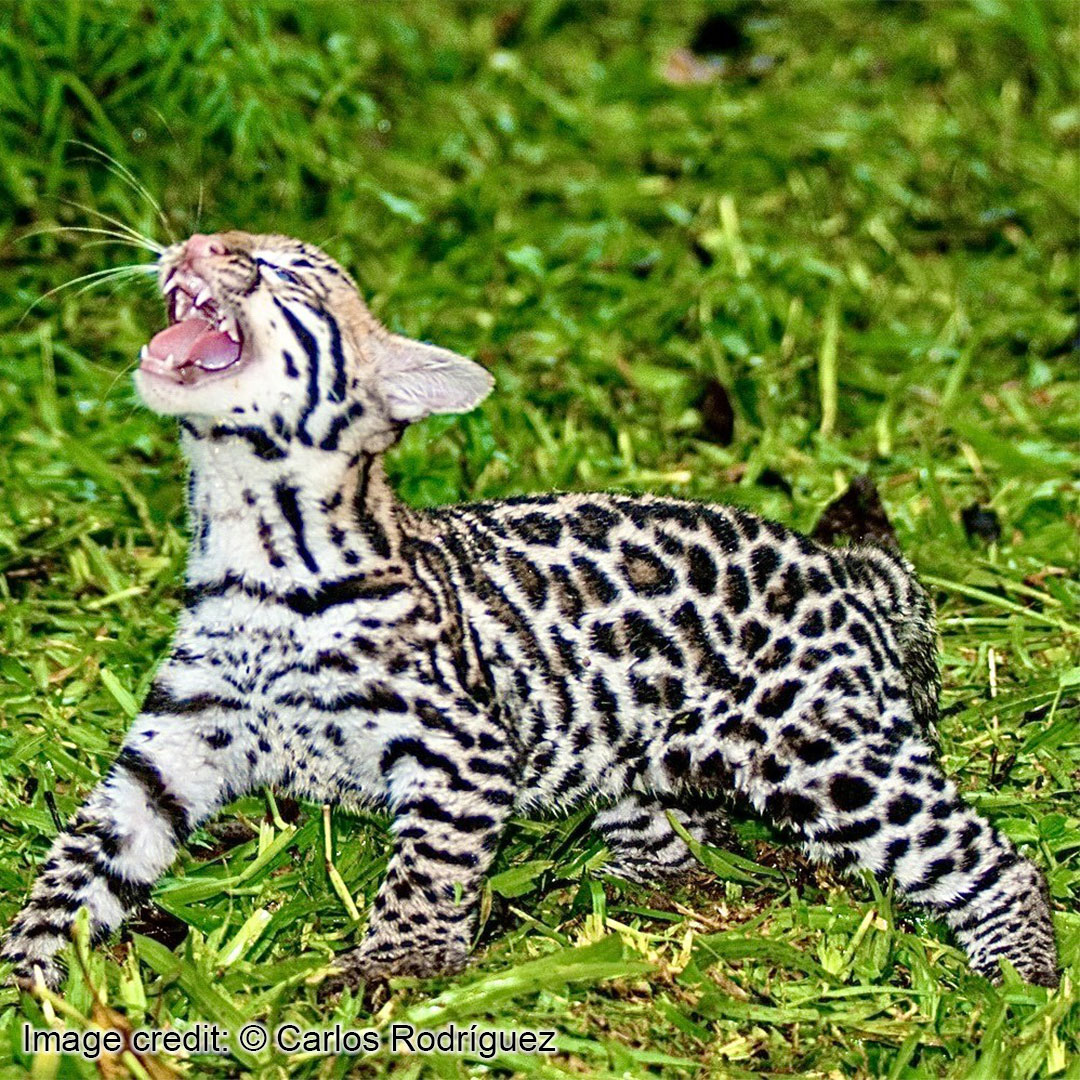
Baby ocelot near the compost area on the farm · Photo: Carlos Rodríguez
Terry and I basically live on a screened porch in the rainforest. We are used to uncommon intruders and unexpected noises. Toucans and iguanas in the house. Jesus Christ lizards in the water garden. Tropical river otters running laps around the living room. Geckos laughing at us from the bamboo ceiling. After nearly three decades here, we are no strangers to rainforest events — and I sleep with a machete on my nightstand.
But then there was that one night.
We were walking home from the lodge when, as we turned onto the path to our house, we heard it: growling, screaming, and the sounds of a physical entanglement. Something was getting mauled — at high pitch, at high speed, with total commitment. The ferocity of it suggested we best find a safe spot away from whatever was happening, and from that prudent perch we courageously called the front desk and asked for a brave Tico to come investigate.
Our dear friend and neighbor Walter hustled over, headed directly into the battle zone, and returned with his assessment: an ocelot had just killed a water opossum.
We knew ocelots were on the property. Just the night before, one had pressed through a loose floorboard in the chicken coop and killed approximately thirty hens. Evidently that ocelot was still hungry — or had told its friends about the excellent dining at Finca Luna Nueva. Either way, we were, as I can only describe it, under ocelot attack.
The Most Beautiful Cat You Will Almost Never See
The ocelot — Leopardus pardalis — is the largest of the small wild cats of the Americas, and arguably the most beautiful. The coat is a masterwork of natural camouflage: a pale tawny base covered with dark rosettes and chain-like markings that dissolve the cat's outline in dappled forest light. No two ocelots share the same pattern, which is how researchers using camera traps can identify individuals. The eyes are large and adapted for low light. The paws are broad and silent.
Adults weigh between eight and eighteen kilograms — roughly the size of a large house cat to a medium-sized dog — and carry themselves with the coiled efficiency of a much larger predator. They are primarily nocturnal and crepuscular, moving through the understory on routes that can extend twenty or more kilometers in a single night. Home ranges on the Caribbean slope of Costa Rica average roughly 26 square kilometers, meaning any ocelot moving through Finca Luna Nueva almost certainly ranges deep into the Children’s Eternal Rainforest corridor as well.
The ocelot is a mesopredator — a mid-level carnivore that preys on rodents, birds, reptiles, opossums, fish, and small mammals. In ecosystems where jaguars and pumas are absent, ocelots can become the primary regulator of prey populations. In ecosystems where all three coexist — as they do in the Arenal region — the ocelot fills a distinct niche, hunting smaller prey in denser cover than either of its larger relatives. We have lost a sow to a jaguar. Pumas have taken pigs and chickens. The ocelot, as we discovered, favors a loose floorboard and an unguarded coop.
The Most Beautiful Coat in the World — Nearly Its Undoing
For much of the twentieth century, the ocelot’s extraordinary coat was also its greatest liability. Between the early 1960s and the mid-1980s, more than 566,000 ocelot pelts were officially traded commercially — and that figure represents only what was declared. The demand was driven by the fashion industry in Europe and North America, and the killing was industrial in scale. An estimated 200,000 ocelots were killed annually at the peak of the trade.
The collapse of the trade came through a combination of legal protection and shifting public sentiment. Costa Rica banned ocelot hunting. In 1989, the species was listed on Appendix I of CITES — the highest level of international trade protection — and imports of spotted cat skins were banned across most consumer countries. The ocelot survived. But populations across Central America are a fraction of what they were, and the species is still listed as having a declining global population despite its current classification as Least Concern on the IUCN Red List.
On the Caribbean slope of Costa Rica — our slope — research has estimated ocelot density at approximately nine to twelve individuals per 100 square kilometers. In that context, a confirmed sighting at Finca Luna Nueva is not a curiosity. It is a data point. It means the corridor is functioning.
The Tithe
Let us be honest about the chicken coop. The ocelot did not break in. It pressed through a loose floorboard — a gap we had failed to secure. The fault was ours, not the cat’s. An ocelot in the wild does what ocelots in the wild should do: it identifies vulnerable prey and takes it. Thirty hens in a single night is a significant loss, and we felt it. But when we ask what went wrong, the answer is not “an ocelot came.” The answer is “we left a door open.”
This is the honest reality of operating a working farm on the edge of a vast primary rainforest. We are not in hiding, and our animals depend on us to provide a secure environment. We do not always succeed. And as this article demonstrates, ocelots will exploit our mistakes with the calm efficiency of a creature from a lineage that has been hunting for millions of years. Our failures have made us smarter and more careful. But we cannot drop our guard for a moment.
Some challenges have no clean solution. The tilapia ponds, for example. There were simply too many herons, river otters, and other predators drawn to them, and managing the losses in a way we were comfortable with proved impossible. We made a decision. The tilapia are gone. The herons and otters remain. We consider that the right outcome, even if it cost us.
We understand that we are sharing this ecosystem. We are not trying to exclude wildlife — we celebrate the appearance of ocelots and otters and jaguars, even when they cost us. There is, we have come to believe, a tithe to the ecosystem that comes with the privilege of farming here. We pay it. It is part of the dance of life, and we would not have it any other way.
The Rainforest Mysteries Trail
The encounter with the water opossum and the chicken coop raid were not our only ocelot stories. For one extraordinary season, our skilled nature guides leading night hikes along the Rainforest Mysteries Trail — our zacate bloc path through the swampy secondary rainforest just steps from our restaurant — encountered an ocelot mother and her cubs on multiple occasions.
The Rainforest Mysteries Trail is a world in miniature at night. Glass frogs clinging to leaves over streams, their translucent bodies showing the outline of beating hearts. Bullet ants navigating the forest floor with terrifying purposefulness. Kinkajous in the canopy above, their eyes catching the beam of a headlamp like amber lanterns. It is a trail designed to show guests what the rainforest becomes when the sun goes down.
And then, on those remarkable nights that season, the headlamps found something else: a female ocelot, compact and precise, moving through the grass-block trail with cubs at her side. She was surely mindful of our nearness — her whiskers probably twitching in anticipation of a needed escape or attack — but she did not flee. She had chosen the Rainforest Mysteries Trail as part of her route, and she was not about to be hurried off it.
A female ocelot with cubs is a statement about a place. She does not raise young in habitat she does not trust. She does not lead her cubs through corridors she has not thoroughly assessed. Her presence on that trail, in that season, was the highest possible endorsement of what Finca Luna Nueva has spent three decades trying to be: a place where the wild things still move freely.
Broad Daylight
And then there was the sighting in the farm, near the compost area, in broad daylight.
Ocelots are primarily nocturnal. A daylight sighting in the open is unusual under any circumstances — and this was not a fleeting shadow at the edge of a camera trap at 3 a.m. This was an ocelot, moving through a working area of the farm, in full light, apparently unbothered by the activity around it.
Carlos Rodríguez photographed the cub you see at the top of this article. Look at it. It is a tyke — not yet a mature hunter, its rosettes still forming, its world still very new. And yet look at the posture. The wide-open mouth. The chin up, the chest forward. This youngster is posing like a champion, willing the world to see it as a force. It has not yet earned that reputation. It is working on it. Vigorously.
We concur with its ambitions.
What It Means to Share
The ocelot visits, the water opossum kill, the chicken coop raid, the mother and cubs on the night hike trail — together these encounters tell a story not just about one beautiful cat but about what kind of place Finca Luna Nueva is. We are a working farm with dairy cattle, pigs, chickens, and tilapia ponds — or had tilapia ponds. We are also, simultaneously, functioning wildlife habitat for jaguars, pumas, ocelots, jaguarundis, margays, river otters, and at least 364 species of birds.
These two things are not in contradiction. They are in tension, and that tension is honest and productive. The ocelot that killed thirty hens taught us to fix the floorboards. The herons and otters that emptied the tilapia ponds taught us the limits of what we could reasonably protect. The jaguar that took the sow reminded us what kind of country we are farming in.
We pay the tithe. We fix the floorboards. We celebrate the cats. And on the nights when the rainforest outside the screened porch fills with sounds we cannot immediately identify, we have learned not to investigate immediately. Better call Walter.
Quick Facts:
Ocelot
| Species: | Leopardus pardalis |
| Common name: | Ocelot | Manigordo (Costa Rica) |
| Weight: | 8–18 kg; roughly house-cat to medium dog in size |
| Activity: | Primarily nocturnal and crepuscular |
| Home range: | ~26 km² on the Caribbean slope — likely extends into the CER corridor |
| Caribbean slope density: | ~9–12 individuals per 100 km² |
| IUCN status: | Least Concern — but declining globally |
| CITES: | Appendix I since 1989 — commercial trade prohibited |
| Sightings at FLN: | Night hike (mother + cubs); daylight near reception; chicken coop raid; water opossum kill |
| What they tell us: | The corridor is functioning. The ecosystem is alive. |
Stop. Look up. Give yourself a moment. You came a long way for this, and it is worth every second.

