


MEET OUR SISTER SPECIES · No. 13
The Two-Toed Sloth: Don’t Let the Face Fool You
June 15, 2026
Posted by: Tom Newmark
Hoffmann’s Two-Toed Sloth: Choloepus hoffmanni
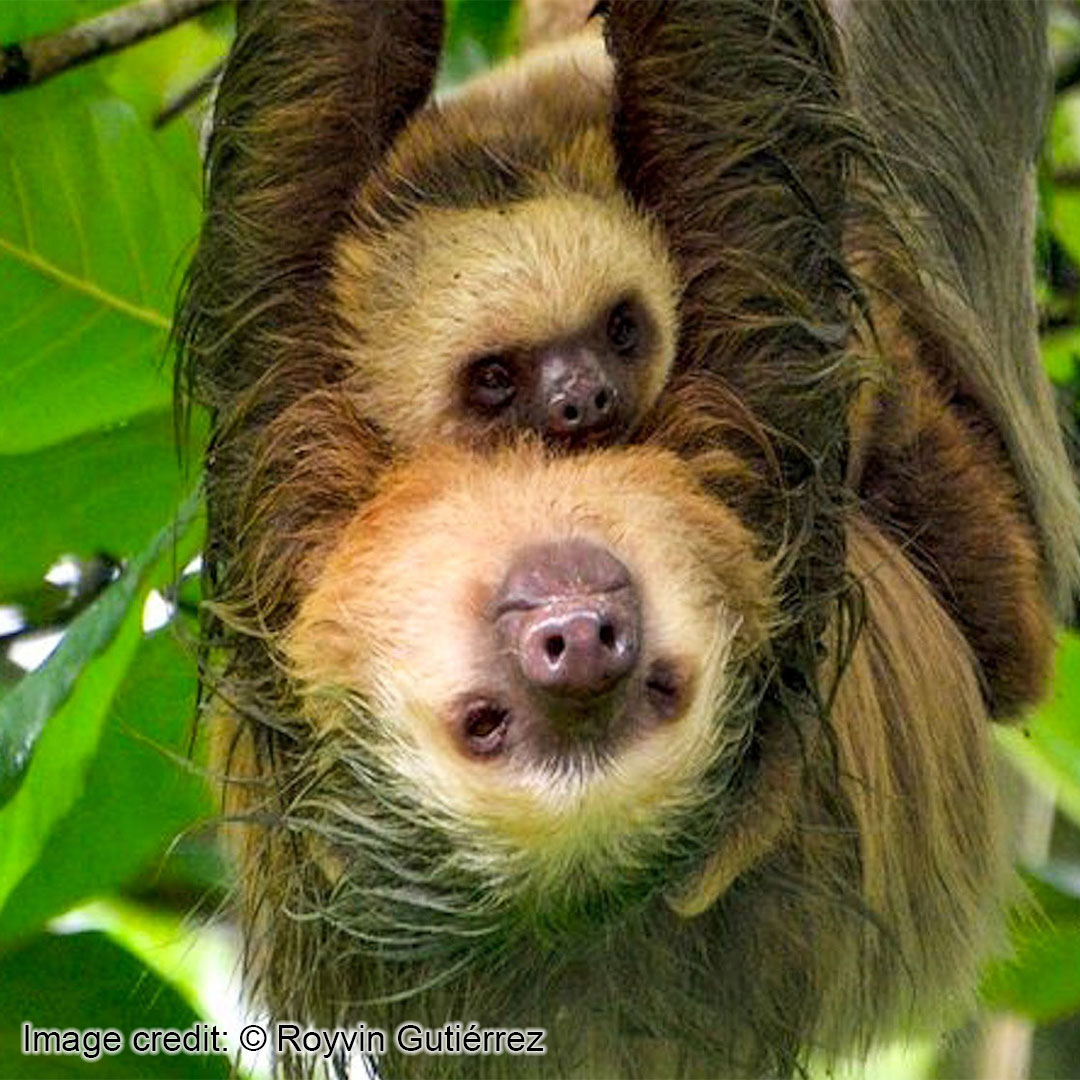
Mother and baby Hoffmann’s two-toed sloth near the reception area at Finca Luna Nueva Lodge · Photo: Royvin Gutiérrez
I have a confession to make. For years, I preferred the three-toed sloth.
If you have spent time in Costa Rica’s rainforests, you understand the temptation. The three-toed sloth — Bradypus variegatus — has a round face, dark mask-like markings around the eyes, and what appears to be a permanent, beatific smile. It is, frankly, designed by evolution to make humans want to protect it. The two-toed sloth — Choloepus hoffmanni — has a longer snout, a pig-like nose, and an expression that suggests it has just read your email and found it wanting. It does not smile. It judges.
And so for years I found myself more drawn to the three-toed. I am not proud of this. It is, as I have come to understand, a failure of attention.
What changed my mind was looking at this photograph. A mother, upside down, looking directly into Royvin Gutiérrez’s lens with complete composure. And behind her, peering over the top of her head like a small furry lookout, her baby. The mothering devotion in that image is not ambiguous. It is not a smile. It is something more serious and more real.
I now equally adore both species. But I had to be shown why. Let me show you.
The Science of Cuteness — and Why It Misleads
What I experienced is not vanity. It is biology. Scientists have a name for it: neoteny — the retention of juvenile features in an adult animal. Large eyes relative to face size, a rounded head, a small nose: these are the features of infant mammals, and human brains are wired to respond to them with nurturing instinct. We evolved to protect babies. We extend that instinct, involuntarily, to animals that share those features.
The three-toed sloth is a neoteny machine. Round face, enormous eyes, permanent upturned mouth. It looks like a stuffed animal that wandered into the canopy. The two-toed sloth has a longer skull to accommodate a different dental arrangement, a more pronounced snout evolved for its more varied diet, and eyes set further apart. It looks like what it is: a larger, more capable, more complex animal. But our brains do not reward capability. They reward roundness.
The result is that the three-toed sloth gets the wildlife photography spreads, the sanctuary fundraisers, and the Instagram following. The two-toed sloth, which is by almost every biological measure the more interesting animal, is somewhat overlooked. This is our mistake. Not the sloth’s.
Two Animals. One Idea. Thirty-One Million Years Apart.
Here is the fact that stops conversations: Choloepus hoffmanni and Bradypus variegatus are not close relatives. Genetic analysis places their divergence at approximately 31 million years ago, deep in the Oligocene epoch. They share a distant common ancestor, but that ancestor did not hang upside down from trees. No known fossil sloth did. The suspensory lifestyle — the hanging, the slowness, the inverted existence — evolved independently, in two separate lineages, over tens of millions of years.
This is convergent evolution: nature arriving at the same solution to the same problem from completely different starting points. It is one of the most extraordinary phenomena in biology, and the sloths are among its most dramatic examples. Two unrelated animals developed the same posture, the same metabolic strategy, the same relationship between fur and algae, and the same basic body plan — not because they inherited it from a common ancestor, but because it works.
The most famous example of convergent evolution is the eye. Your eye and the eye of an octopus are structurally nearly identical: lens, retina, iris, pupil, the same basic optics. Yet vertebrates and cephalopods diverged from a common ancestor so ancient it had no eyes at all. Both lineages arrived at the same solution to the same existential problem — how do you see in a complex world? — completely independently. The octopus’s retina is even wired more elegantly than ours, with the photoreceptors facing the light rather than away from it. Same destination. Different engineering. Different timeline.
The sloths present something even more remarkable than a single shared structure. They converged on an entire lifestyle. Not just a feature. A complete ecological strategy, repeated twice, from different ancestral starting points, across thirty-one million years. When nature arrives at the same answer twice, it is telling you something important: that answer is very, very good.
There is one more thread worth pulling. The giant ground sloths that crossed the Panamanian land bridge into North America during the Great American Biotic Interchange some 2.6 million years ago — animals like Megalonyx, which ranged as far north as Alaska and weighed up to 1,300 kilograms — belong to the family Megalonychidae. That is the same family as Choloepus hoffmanni. The two-toed sloth in the beach almond tree at our reception is, in the contested but evocative language of paleontology, a living cousin of the giants that once walked this hemisphere. The science is still being refined — molecular and morphological analyses disagree on the precise relationships — but the family connection holds.
The esteemed scientist William Haber, a botanist who has been researching plants and insects in Costa Rica since 1972 and co-authored Dragonflies and Damselflies of Costa Rica (Cornell University Press, 2021), once visited Finca Luna Nueva and drew my attention to something remarkable: many tree species in this region evolved spikes, thorns, and armored bark specifically to deter the giant sloths from excessive herbivory. Those defensive structures are still there. The giant sloths were wiped out by human predation roughly 13,000 years ago. But trees have a long memory.
What the Two-Toed Sloth Actually Is
Hoffmann’s two-toed sloth is the larger of the two Costa Rican sloth species, typically 58 to 70 centimeters in body length and weighing between four and eight kilograms. It is primarily nocturnal — which is one reason the beach almond tree near our reception area, checked by our guides as every night hike begins, is the right place to look. The three-toed sloth will sometimes oblige in daylight. The two-toed keeps more sensible hours.
Where the three-toed is a dietary specialist — eating almost exclusively leaves, primarily from a small number of preferred tree species — Choloepus hoffmanni is a generalist. Its diet includes leaves, fruits, flower buds, twig tips, young stems, tree sap, and apparently some animal matter. In Costa Rica alone it has been observed feeding from 34 different tree species. It is, in the most literal sense, a more sophisticated eater, and its more complex diet requires a longer period of maternal education to transmit. Young two-toed sloths remain dependent on their mothers for six to nine months — among the longest dependency of any sloth species — learning what to eat, how to find it, and how to navigate the canopy.
The slowness, in both species, is not a failure. It is the strategy. Leaves are nutritionally poor and often chemically defended. The two-toed sloth’s multi-chambered stomach ferments food for up to a month, extracting maximum nutrition from minimal input. The slow metabolism means the animal needs very little food. The slow movement means it generates almost no heat signature and almost no visual cue for predators that hunt by motion. The sloth is not a failed fast animal. It is a supremely successful slow one.
And the fur is an ecosystem. The outer coat is grooved in a way that collects moisture and encourages the growth of algae — giving the fur its greenish tinge, which functions as camouflage in the dappled canopy light. Moths, beetles, mites, and fungi complete the community. The sloth does not merely live in the rainforest. It carries a piece of the rainforest on its back.
The Weekly Ritual — and Why It Matters
Once a week, the two-toed sloth descends from the canopy to the base of its favorite tree to urinate and defecate. This is, by any measure, a dangerous journey. On the ground, the sloth is slow and vulnerable. Predators are real. The energetic cost of the descent is significant for an animal that manages its energy budget with extreme care.
So why do it? The honest answer is that scientists are not entirely sure. One compelling theory: the descent is not for the sloth’s benefit at all. It is for the moths. Pyralid moths live in sloth fur. They lay their eggs in sloth dung. The weekly descent is the delivery system — the sloth risks its life to provide the moths with a nursery. In return, the moths die in the fur, providing nutrients that feed the algae. The algae feeds and camouflages the sloth. The sloth descends weekly to keep the cycle going.
It is, in other words, a mutualism so tightly interwoven that the sloth’s most dangerous weekly behavior exists to sustain the tiny ecosystem it carries. Every Thursday — or whatever day the sloth has chosen — it climbs down into danger so that the moths can have what they need. Whether or not it knows this is irrelevant. The system works.
What Changed My Mind
Look again at Royvin’s photograph. The baby is not holding on because it has been placed there. It is holding on because in the first months of its life, its mother is the entire world. Everything it will learn about the rainforest — which trees produce fruit in which season, which canopy routes lead where, which leaves are safe and which are defended with toxins — will come from her. Six to nine months of close observation, near-constant contact, and gradual release.
The three-toed sloth mother is devoted. But she is transmitting a simpler program: eat these leaves, stay slow, trust the camouflage. The two-toed sloth mother is transmitting something closer to a curriculum. The generalist’s life requires generalist knowledge, and generalist knowledge must be learned. That baby, peering over its mother’s head with its eyes wide open, is already in school.
This is what converted me. Not the face. The fact.
The Beach Almond Tree at Reception
Finca Luna Nueva has a longstanding resident population of Hoffmann’s two-toed sloths. They are most reliably found in a beach almond tree — almendro de playa, Terminalia catappa — near our reception area. Our nature guides know to check that tree as every night hike begins. Quite often, there is a sloth there.
The beach almond is not a coincidence. Terminalia catappa is one of the 34 tree species recorded in the diet of Choloepus hoffmanni in Costa Rica. The sloth is not visiting randomly. It is using the tree for what the tree provides: food, cover, a reliable anchor point in a home range that may span several hectares. The fact that the reception area is nearby is, from the sloth’s perspective, irrelevant. The sloth was here before the lodge. In some sense, the lodge was built in the sloth’s neighborhood.
Guests who arrive after dark, gathering at the trailhead before the night hike, sometimes see a pair of eyes looking back at them from the beach almond tree before the guide has said a word. Upside down. Unhurried. Judging, a little. But there. And once you know what you are looking at — once you understand that the animal above you is carrying an ecosystem on its back, ferrying moths to a nursery once a week at genuine personal risk, teaching a baby the curriculum of the rainforest — the face stops mattering entirely.
A footnote worth flagging, and one I intend to develop more fully in a future article in this series: the beach almond is not native to Costa Rica. It is native to tropical Asia — India, Australia, the Pacific — and has been naturalized here for centuries. Our resident sloths have adopted an introduced tree as their anchor point. Our resident Scarlet Macaws, as I described in No. 11 of this series, roost in Honduran pines we inherited from a prior owner and continue to care for pursuant to Terry’s directive. In both cases, a species introduced by human hands has become an indispensable refuge for a native animal. The implications for how we think about “native” and “invasive” are worth a careful conversation — one I intend to have with Willow Zuchowski, William Haber’s wife and fellow biologist, who is the founder of ProNativas, an organization devoted to promoting native plant species in Costa Rica. Her perspective on our pines and our beach almonds will be illuminating. More on this later.
Equally Adored
I will not argue that the two-toed sloth is more beautiful than the three-toed. Beauty is what it is. But I will argue, with some confidence after nearly three decades in this rainforest, that the two-toed sloth is more interesting. It is larger, faster, more adaptable, more complex in its diet, more demanding in its parenting, and more deeply embedded in a web of mutualistic relationships that extend from moths to algae to the trees it feeds in.
The three-toed sloth perfected one answer to the question of how to survive. The two-toed sloth developed a slightly more complex answer, independently, from a different starting point, over millions of years. Both answers are extraordinary. Both animals deserve our attention.
Don’t let the face fool you. Check the beach almond tree.
With thanks to Royvin Gutiérrez, local expert nature guide, for the photograph that led to my epiphany — and for his generous vetting of this article.
Quick Facts:
Hoffmann’s Two-Toed Sloth
| Species: | Choloepus hoffmanni |
| Common name: | Hoffmann’s Two-Toed Sloth | Perezoso de dos dedos (Costa Rica) |
| Size: | 58–70 cm body length; 4–8 kg |
| Activity: | Primarily nocturnal |
| Diet: | Omnivorous generalist — leaves, fruits, flowers, sap, some animal matter; 34 tree species recorded in Costa Rica |
| Digestion: | Multi-chambered stomach; up to one month to fully process food |
| Weekly ritual: | Descends to defecate once per week — possibly to sustain the moth-algae-sloth mutualism |
| Maternal care: | 6–9 months of dependency; among the longest of any sloth species |
| Convergent evolution: | Diverged from three-toed sloths ~31 million years ago; suspensory lifestyle evolved independently |
| At FLN: | Longstanding resident population; most reliably seen in beach almond tree near reception on night hikes |
| IUCN status: | Least Concern |
Stop. Look up. Give yourself a moment. You came a long way for this, and it is worth every second.

