


MEET OUR SISTER SPECIES · No. 15
Someone to Watch Over Me: The King Vulture
June 29, 2026
Posted by: Tom Newmark
King Vulture: Sarcoramphus papa
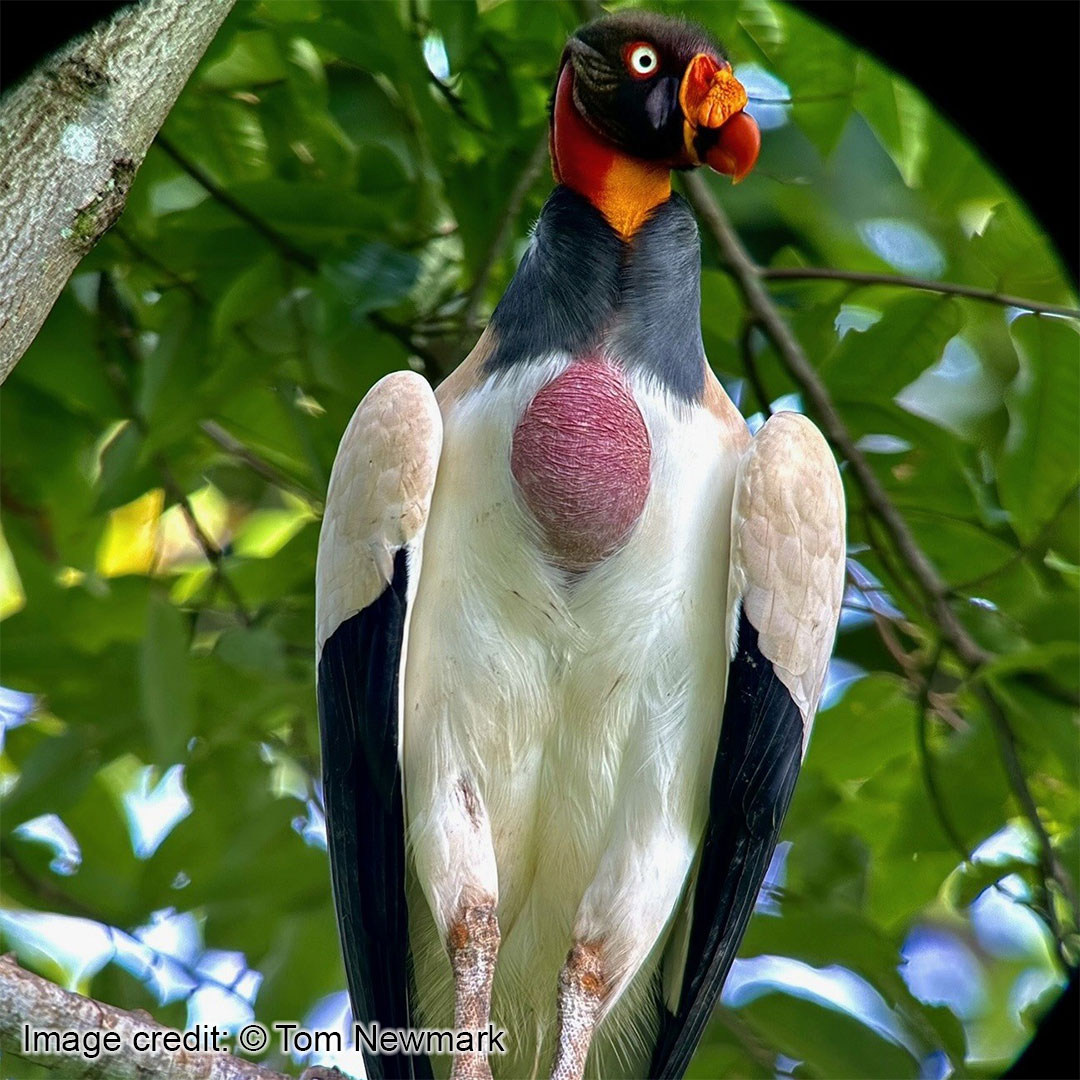
King Vulture photographed through a spotting scope at Finca Luna Nueva Lodge · Photo: Tom Newmark
Look at that face.
The orange caruncle above the beak. The multicolored bare head — yellow, orange, red, purple, all at once — like something a rainforest painter designed on a dare. The pale eye with its orange ring, watching you with the calm certainty of an animal that has been doing this job since before your species existed. I photographed this bird through my spotting scope in the canopy at Finca Luna Nueva, and I will confess: even through the lens, the King Vulture has a way of making you feel observed rather than observer.
Most people, encountering a vulture, feel something between unease and contempt. The bald head. The hunched posture. The association with death and rot. We have made the vulture into a symbol of something sinister.
We have it exactly backwards.
The Immune System of the Rainforest
Your body has an immune system. When a pathogen — a virus, a bacterium, a fungus — enters your body, specialized cells respond. Killer T-cells identify and destroy infected cells. Macrophages engulf and digest pathogens. The system is not glamorous. It involves things you would rather not think about. But without it, a minor infection becomes a death sentence.
The rainforest has an immune system too. And the King Vulture — Sarcoramphus papa — is one of its most critical components.
When an animal dies in the rainforest, its body does not simply disappear. It becomes a reservoir of pathogens. The bacteria and viruses and fungi that killed it — anthrax, botulism, cholera, rabies, salmonella, tuberculosis — do not die with their host. They multiply in the cooling flesh, and without intervention, they leach into the soil and the waterways, spreading to other animals and ultimately to humans. A single unprocessed carcass in a tropical environment is a biological bomb with a slowly burning fuse.
The King Vulture, and the guild of vultures that surrounds it, defuses that bomb. They locate the carcass, consume it entirely — flesh, organs, bones — and destroy every pathogen in the process. What enters the vulture as a biological hazard exits as harmless waste. The rainforest’s immune response has fired, the threat has been neutralized, and the ecosystem moves on.
The Most Acidic Stomach on Earth
The mechanism that makes this possible is extraordinary. The vulture’s stomach acid has a pH of approximately 0 — the most corrosive digestive fluid in the animal kingdom. To understand what that means, consider the scale. Battery acid — the sulfuric acid in a car battery, which burns skin on contact — has a pH of roughly 0 to 1. Human stomach acid sits at pH 1.5 to 2. Lemon juice is pH 2. Vinegar is pH 2.5. Coffee is pH 5.
The vulture’s gut operates at or below battery acid levels. It is, in the most literal sense, one of the most corrosive environments on the planet that is also inside a living animal.
At that pH, anthrax spores are destroyed. Botulinum toxin is neutralized. Cholera bacteria, rabies virus, tuberculosis, salmonella, leprosy — all are dissolved. The vulture does not merely tolerate these pathogens. It annihilates them. It is a walking, flying sterilization unit, processing biological hazards that would kill almost any other vertebrate within hours of ingestion.
Think of it this way: when a macrophage in your immune system engulfs a pathogen, it destroys it through a combination of enzymes and reactive oxygen species. The vulture’s stomach does something functionally equivalent, but at ecosystem scale. One bird. One carcass. The pathogen load of an entire dead animal, neutralized.
The Vulture Guild: Division of Labor
The King Vulture does not work alone. In Costa Rica, three New World vulture species share the ecosystem: the Turkey Vulture, the Black Vulture, and the King. Each has specialized for a different role, and together they form a remarkably efficient pathogen-clearance system.
The Turkey Vulture (Cathartes aura) is the scout. It possesses one of the most highly developed senses of smell in the bird world — it can detect the volatile compounds of decomposition at concentrations of a few parts per trillion, locating carcasses hidden under a closed forest canopy that no other vulture could find by sight. In a rainforest, where the canopy is continuous and dense, the Turkey Vulture is indispensable. It finds the body.
The Black Vulture (Coragyps atratus) is the opportunist. It cannot smell — its olfactory system is comparatively rudimentary — but it watches the Turkey Vulture. Where the Turkey Vulture descends, the Black Vulture follows. It is faster, more aggressive, and arrives in numbers. It signals the carcass to every other vulture in visual range.
The King Vulture is the can-opener. It cannot smell either, and it follows the Turkey Vulture’s behavior and the Black Vulture’s congregation. But when it arrives, everything changes. The King is the largest of the New World vultures in this region, with a wingspan up to two meters and a beak powerful enough to tear through the thick hides of large mammals that the smaller vultures’ beaks cannot penetrate. Without the King’s initial cut, a carcass in a tough hide would be largely inaccessible to the rest of the guild. The King eats first, tears the carcass open, and in doing so feeds the entire system.
Scout. Signaler. Opener. Three species, three specializations, one function: the carcass disappears, and the pathogens go with it.
When the Immune System Fails: India’s Catastrophe
We have proof of what happens when vultures disappear. The evidence comes from India, and it is among the most consequential ecological disasters of the past century.
The Parsi people — followers of Zoroastrianism, one of the world’s oldest religions — have for millennia disposed of their dead in Dakhmas: structures known in the West as Towers of Silence. Built on hills or elevated ground, these circular stone platforms expose the bodies of the deceased to the open sky. The doctrine holds that earth, water, fire, and air are sacred elements that must not be polluted by the dead. The flesh is given to the birds. It is an act of final generosity — the body returned to the ecosystem that sustained it.
For thousands of years, the system worked. Vultures — primarily the white-rumped vulture (Gyps bengalensis) — consumed a body within hours of exposure. No corruption. No disease. Mark Twain, who attended a Parsi funeral in Bombay in 1897, wrote that the ceremony “disseminates no corruption, no impurities of any sort, no disease-germs.” The vultures made that possible.
In the early 1990s, India authorized the veterinary use of diclofenac — a cheap anti-inflammatory painkiller, similar to ibuprofen, used to treat pain and fever in livestock. Farmers used it widely. Cattle treated with diclofenac died, as cattle do, and the carcasses entered the food supply of the vultures. Diclofenac is catastrophically toxic to vultures: it causes kidney failure within days of ingestion. A vulture that feeds on a single diclofenac-treated carcass is almost certainly dead within a week.
By the early 2000s, India had lost up to 99 percent of its Gyps vulture populations. Three species declined by more than 99 percent within a decade — one of the fastest collapses of a vertebrate population ever recorded. The Towers of Silence fell silent for a different reason: there were no vultures left to do their work. Bodies decomposed over weeks and months instead of hours. The Parsi community installed solar reflectors to hasten decomposition. They planted trees to attract less efficient scavengers. Nothing worked as well as the vultures had.
And then the human death toll began to emerge.
A landmark study published in the American Economic Review in 2024 quantified the human cost by comparing death rates in districts with historically high vulture populations to those with historically low ones. The result was stark: a 4.2 percent increase in all-cause human death rates in areas where vultures had disappeared. The mechanism was not mysterious. Without vultures to process carcasses, rotting bodies contaminated water sources. Dog populations — which competed with vultures for carrion — exploded when the competition disappeared, and dogs are the primary vector for rabies in India. The pathogens the vultures had been neutralizing for millennia were now leaching into the groundwater and into the food supply. The study estimated more than 100,000 additional human deaths per year, and economic losses of $69.4 billion annually.
India banned veterinary diclofenac in 2006. But vultures breed slowly — one egg per year, eight months per breeding cycle — and populations decimated by 99 percent do not recover quickly. Decades of work remain.
Silent Spring, Revisited
The diclofenac story is Rachel Carson’s story, told again fifty years later.
In Silent Spring, published in 1962, Carson documented the catastrophic effects of DDT on birds of prey — particularly the thinning of eggshells that caused reproductive failure in eagles, ospreys, and peregrine falcons. The mechanism was biomagnification: DDT introduced at low concentrations into the food chain accumulated and intensified at each trophic level, so that apex predators — the animals eating other animals that had eaten other animals — accumulated concentrations thousands of times higher than the original application.
Diclofenac followed the same logic. A drug introduced at one trophic level — given to livestock to reduce their pain — became concentrated and lethal at the next trophic level, when vultures consumed the treated carcasses. The compound itself did not change. The food chain amplified it into a catastrophe.
Carson’s book changed the world. The DDT ban that followed allowed raptors to recover over decades. The diclofenac story — less famous, more recent, and in some ways more devastating in its human consequences — is still being written. It is a reminder that the connections between what we introduce into ecosystems and what emerges at the other end of the food chain are not always visible until the immune system fails.
The King at Finca Luna Nueva
The King Vulture is a bird of undisturbed lowland tropical forest. It requires large tracts of intact habitat, low human disturbance, and a functioning ecosystem to support its role. It is not common. A sighting is an event.
We see them at Finca Luna Nueva. The photograph at the top of this article was taken through my spotting scope — the King in the canopy, looking sideways with that extraordinary face, entirely unbothered. Approximately 60 percent of Finca Luna Nueva’s 127 acres is protected rainforest — land we placed into conservation ourselves. Through active restoration, we rebuilt the wildlife corridor connecting our protected forest to the Children’s Eternal Rainforest, the vast protected complex that is the Mother of this ecosystem. Our land is now part of that system. That connectivity provides the habitat depth the King Vulture requires to range and function. Our pesticide-free farming means that any animal that dies on or near the property is safe for the vulture guild to process — no diclofenac risk, no silent spring of our own making.
We pay attention when the King Vulture appears. It is telling us something important: that the corridor is intact, that the ecosystem is functioning, that the immune system of the rainforest is on duty.
Someone to Watch Over Me
George and Ira Gershwin wrote “Someone to Watch Over Me” in 1926. The lyric goes: he may not be the man some girls think of as handsome — but to my heart he carries the key.
The King Vulture is not the bird most people think of as beautiful. The bare head, the hunched posture at rest, the association with carrion — none of it plays well on first impression. But beauty, as anyone who has spent time in a rainforest learns, is not the right framework for evaluating an ecosystem. Function is. And the function of the vulture guild — the Turkey Vulture that smells death from miles away, the Black Vulture that signals its location to the guild, the King that tears it open and neutralizes every pathogen inside — is among the most consequential in the entire rainforest.
Remove the vultures, and within a generation, the water is contaminated, the dog populations explode, the rabies cases multiply, and people start dying at a measurably higher rate. We know this now. India proved it.
Keep the vultures — keep the forest intact, farm without poison, protect the corridors that allow them to range — and the immune system of the rainforest continues its ancient work. Quietly. Efficiently. Unglamorously. Without asking for our admiration.
It is very good to have the King watching over us.
Quick Facts:
King Vulture
| Species: | Sarcoramphus papa |
| Common name: | King Vulture | Zopilote rey (Costa Rica) |
| Wingspan: | Up to 2 meters |
| Weight: | 2.7–4.5 kg |
| Stomach pH: | ~0 — equal to battery acid; strongest in the animal kingdom |
| Pathogens destroyed: | Anthrax, botulism, cholera, rabies, salmonella, tuberculosis, and more |
| Role in guild: | The can-opener — tears open hides other vultures cannot penetrate |
| Locates carcasses: | By sight and by watching Turkey Vultures and Black Vultures |
| Range: | Southern Mexico to northern Argentina; lowland tropical forest |
| IUCN status: | Least Concern — but dependent on intact forest and pesticide-free habitat |
| At FLN: | Confirmed sightings; indicator of functioning ecosystem and intact corridor |
Stop. Look up. Give yourself a moment. You came a long way for this, and it is worth every second.

