


MEET OUR SISTER SPECIES · No. 14
Fruta Dorada: The Stairway Not to Heaven
June 22, 2026
Posted by: Tom Newmark
Fruta Dorada: Virola sebifera
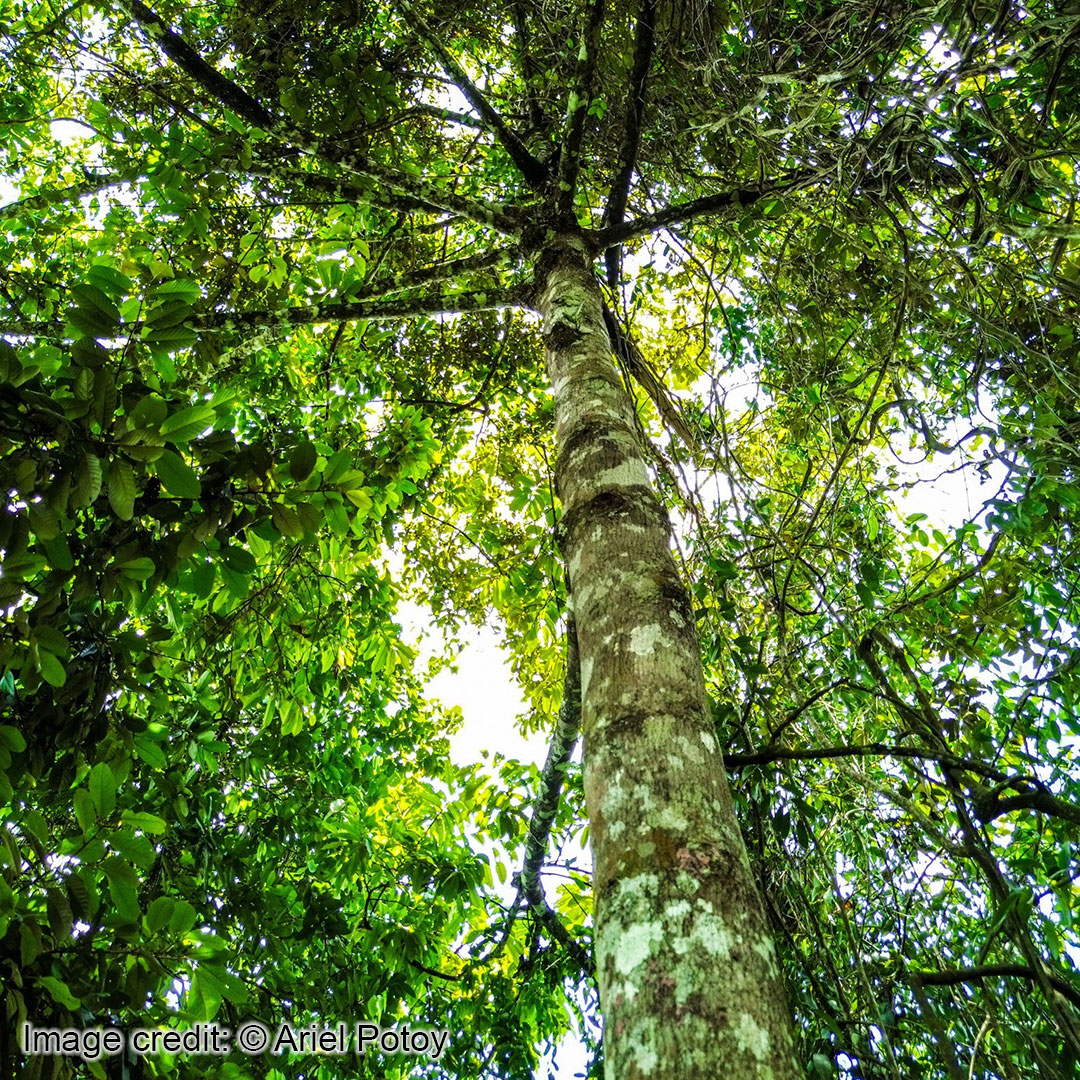
Virola sebifera on the Rainforest Mysteries Trail at Finca Luna Nueva Lodge · Photo: Ariel Potoy
Look up at the photograph. Ariel Potoy stood at the base of this tree on the Rainforest Mysteries Trail — just steps from our restaurant — and pointed his lens straight up. What he captured is the trunk of Virola sebifera rising toward the canopy, its limbs spiraling outward in a perfect helix, each branch a landing on a staircase that goes only one direction: up.
It is one of the most beautiful trees in our rainforest. It is also one of the most pharmacologically potent.
The bark of Virola sebifera — known in Costa Rica as Fruta Dorada, or Golden Fruit — contains concentrations of dimethyltryptamine, or DMT, and its close relative 5-MeO-DMT that can reach eight percent of the resin’s weight. This is among the highest natural concentrations of psychoactive alkaloids found in any tree on Earth. Shamans across the Amazon and Orinoco basins have known this for millennia. They scraped the inner bark, dried the resin, ground it to powder, and inhaled it. The effects, by all accounts, were immediate, overwhelming, and in some cultural contexts, specifically designed to be terrifying.
The stairway in this photograph does not lead to heaven.
The Tree Itself
Fruta Dorada belongs to the family Myristicaceae — the nutmeg family. This is not a coincidence. The seeds of Virola sebifera smell unmistakably of nutmeg. The family has been producing psychoactive compounds for a very long time, and nutmeg itself is technically a hallucinogen — its compound myristicin is metabolized in the body into MMDA, a substance with genuine psychedelic properties. The catch: the dose required to produce hallucinations is also a toxic dose. Effects take three to six hours to appear, can persist for up to 72 hours, and at higher doses can be fatal. The Myristicaceae family, in other words, found a remarkable internal balance: Virola sebifera concentrates its alkaloids in the bark resin, where indigenous peoples learned to use them with precision. Nutmeg distributes its psychoactive compounds through the seed at concentrations so low that the quantity you put in your eggnog is approximately a thousand times below any psychoactive threshold. Same family. Profoundly different pharmacology. The spice on your kitchen shelf is a distant, well-behaved cousin of the tree on our trail.
The tree is a common understory species in Costa Rica, found on both slopes from sea level to 1,000 meters. It reaches 10 to 20 meters in height, with the characteristic spiral limb arrangement that Ariel’s photograph captures so beautifully. The inner bark, when cut, exudes a reddish resin. The fruits are small, reddish ovals — the “fruta dorada” for which the tree is named — eaten by monkeys, toucans, and guans. It is a tree of enormous ecological importance, quietly feeding the canopy, even more quietly harboring a pharmacy in its bark.
It is native to this rainforest. It was here before any of us.
The Problem With DMT — and How It Was Solved Three Ways
DMT is one of the most powerful psychedelic compounds known to science. It is also, remarkably, produced naturally by the human body in trace amounts — its precise physiological function remains one of the more intriguing open questions in neuroscience. When introduced externally in sufficient doses, it produces experiences that users describe as the most intense of their lives: visual and auditory hallucinations of extraordinary complexity, contact with what many report as other beings or presences, dissolution of the sense of self.
There is, however, a significant pharmaceutical problem. The human body destroys DMT almost instantly. An enzyme in the gut called monoamine oxidase breaks it down before it can reach the brain. For a compound of such potency, it is almost comically well-defended against oral ingestion.
Indigenous peoples of the Americas solved this problem at least three different ways — and each solution is a feat of empirical pharmacology achieved without laboratories, without chemistry degrees, and without written language.
The snuff route: Bypass the stomach entirely. Virola resin, and the seeds of the yopo tree (Anadenanthera peregrina), were dried and powdered and blown directly into the nasal passages through a long tube. Insufflation delivers the compound directly to the bloodstream through the nasal mucosa. The effects arrive within seconds. They are, by all accounts, immediate and ferocious.
The vine route: Disable the enzyme. Ayahuasca — the ceremonial brew of the Amazon — combines the leaves of Psychotria viridis, which contain DMT, with the vine Banisteriopsis caapi, which contains beta-carboline alkaloids that are powerful monoamine oxidase inhibitors. Drink the vine’s chemistry first, and the gut’s defense system is chemically neutralized. The DMT in the leaves then survives digestion and reaches the brain intact. The experience lasts hours, not minutes. It is slow, deep, and deliberate — a very different journey than the snuff route.
The decoction route: The most remarkable solution of all — one that requires no second plant, no vine, no ash-and-lime preparation. Virola bark contains not only DMT and 5-MeO-DMT but also beta-carboline alkaloids: the same class of monoamine oxidase inhibitors found in the ayahuasca vine. The tree contains its own enzyme inhibitor alongside its own psychoactive compound. Some tribes boiled the bark resin directly into a paste or drink, because Virola had already assembled both ingredients in the same bark. The tree solved the pharmaceutical problem internally, in a single organism, over millions of years of evolution. Three solutions. The same molecule. One of the more remarkable examples of independent problem-solving — human and botanical alike — in the history of pharmacology.
The Yanomami and the Waterfall
The Yanomami people of the Venezuelan and Brazilian Amazon are among the peoples most closely associated with Virola use. Their preparation, called ebene, was made from the resin of Virola theiodora and related species, dried and blown through a long tube into the nostrils of the recipient by a second person. This was not a ceremony restricted to shamans: all male members of the tribe over fourteen were encouraged to partake.
The physiological effects reported by observers include a violent onset: a cascade of mucus, disorientation, what some accounts describe as impulses toward aggression. Other Amazonian tribes mixed the Virola powder with additional plant material, apparently tempering the experience into something more navigable. There is a story — perhaps apocryphal, certainly vivid — that those other tribes did not share this refinement with the Yanomami. They wanted nothing to do with what happened when the Yanomami snorted pure ebene.
The Yanomami lived, and live, thousands of kilometers from Costa Rica and Panama. But Virola sebifera grows on our Rainforest Mysteries Trail. The stairway is right here.
Don’t Mess With a High-School Science Teacher!
Some people are tough enough to run giant corporations, head up governments, or coach professional athletes. It takes a ton of moxie to run those organizations — but there is a more exalted challenge: teaching high school science. That’s where our dear and departed friend Rachel Crandall joins this story.
For many years Rachel taught science in a St. Louis high school. She became acutely aware of the glories and the needs of the Children’s Eternal Rainforest, and she did something about it. Rachel created the Monteverde Conservation League—US, a not-for-profit organization singularly focused on this rainforest. Her husband Dwight was the head of the St. Louis Science Center, and together they poured their hearts, souls, and strong backs into financially and physically supporting this critical rainforest fragment. My friend Dr. Peter Raven — then president of the Missouri Botanical Garden and one of the great botanists of our time — introduced me to the Crandalls, whereupon I joined Rachel, Peter, and other inspiring people on the US board. One of those board members was Doctora Julia Matamoros of Costa Rica.
Julia, Rachel, and I joined a few friends about fifteen years ago on a twenty-five mile hike from Monteverde to Poco Sol — essentially one side of the Children’s Eternal Rainforest to the other, across mountains, valleys, snake-infested forests, and other crazily untamed environments. I will note, without further elaboration, that I was carted out on a stretcher. That story, and the new knee that followed, is for another day. We made this walk accompanied by the New York Times, and we raised both awareness and money for the forest. Rachel, and soon thereafter Peter, were honored guests at Finca Luna Nueva. Julia is one of those special souls who instantly becomes family — she is a serious regular at our lodge.
On one of Rachel’s many trips to Central America — working, as she put it, “for the forest” — she visited tribal regions of Panama and encountered the Emberá, a people of the wild Darién. The Emberá occupied a particular niche in the human tribal ecosystem: they were warriors. Rachel found herself face to face with a high-ranking Emberá warrior who had unsurprisingly never met a Caucasian woman — especially one with the fierce visage of a high-school science teacher. A stare-down ensued. Personal space was invaded. Tall and powerful warrior met short and white-haired science teacher.
Rachel processed the scene. And she noticed that the warrior had a large hole in one earlobe — where ornaments must once have been worn. So she did what you and I would never do: she inserted her finger into that hole. The warrior went silent. After a fraught few moments, he broke into laughter. A fragile friendship was forged on the spot.
She returned from the Darién with her head on her shoulders and with several woven Emberá sculptures made from chunga palm fiber — beige and black, intricate and durable. An Emberá armadillo now sits in my office at the farm.
I can only assume the warrior had not snorted Fruta Dorada before meeting Rachel.
In Memoriam
From time to time the Crandalls come into my awareness, and I reflect with great fondness on their roles in Terry’s and my life and their inspiring action “for the forest.” The world is so uplifted by people like Dwight and Rachel.
Dr. Peter H. Raven, who introduced us to the Crandalls, who visited Finca Luna Nueva, and who spent nearly forty years transforming the Missouri Botanical Garden into one of the world’s great centers for plant science and conservation, died on April 25, 2026, at the age of 89. He was among the most consequential botanists of the twentieth century. He coined the word “coevolution.” He warned for decades about the mass extinction of plant species at a time when few were listening. He connected people to each other and to the natural world with a generosity and a humor that everyone who knew him will carry for the rest of their lives.
The tree on the Rainforest Mysteries Trail — the stairway that does not lead to heaven — is the kind of thing Peter Raven would have stopped to examine carefully. He would have known its family, its alkaloids, its range, its ethnobotanical history. He would have found it wonderful.
It is wonderful. Look up.
The Tree on the Trail
You do not need to go to the Amazon to stand in the presence of Virola sebifera. You need only walk the Rainforest Mysteries Trail at Finca Luna Nueva — our zacate bloc path through the swampy secondary rainforest, just steps from the restaurant, one of the stops on our evening night hikes. The tree is there. The spiral limbs are there. The reddish bark is there.
We do not recommend snorting it. We do recommend looking up.
Quick Facts:
Fruta Dorada
| Species: | Virola sebifera |
| Common name: | Fruta Dorada | Red ucuuba |
| Family: | Myristicaceae — the nutmeg family |
| Height: | 10–20 meters; understory to occasional subcanopy |
| Range: | Both slopes of Costa Rica, sea level to 1,000 m; Honduras to Brazil |
| Active compounds: | DMT and 5-MeO-DMT in bark resin; up to 8% alkaloid concentration |
| Ethnobotanical use: | Hallucinogenic snuff (ebene) used by Yanomami and other Amazonian tribes |
| Fruit: | Small reddish ovals; eaten by monkeys, toucans, and guans |
| Seed smell: | Unmistakably of nutmeg — same plant family as Myristica fragrans |
| At FLN: | Present on the Rainforest Mysteries Trail; observed on night hikes |
Stop. Look up. Give yourself a moment. You came a long way for this, and it is worth every second.

