


MEET OUR SISTER SPECIES · No. 8
It Depends
May 11, 2026
Posted by: Tom Newmark
Angel’s Trumpet (Reina de la Noche): Brugmansia × candida (or closely related hybrid)
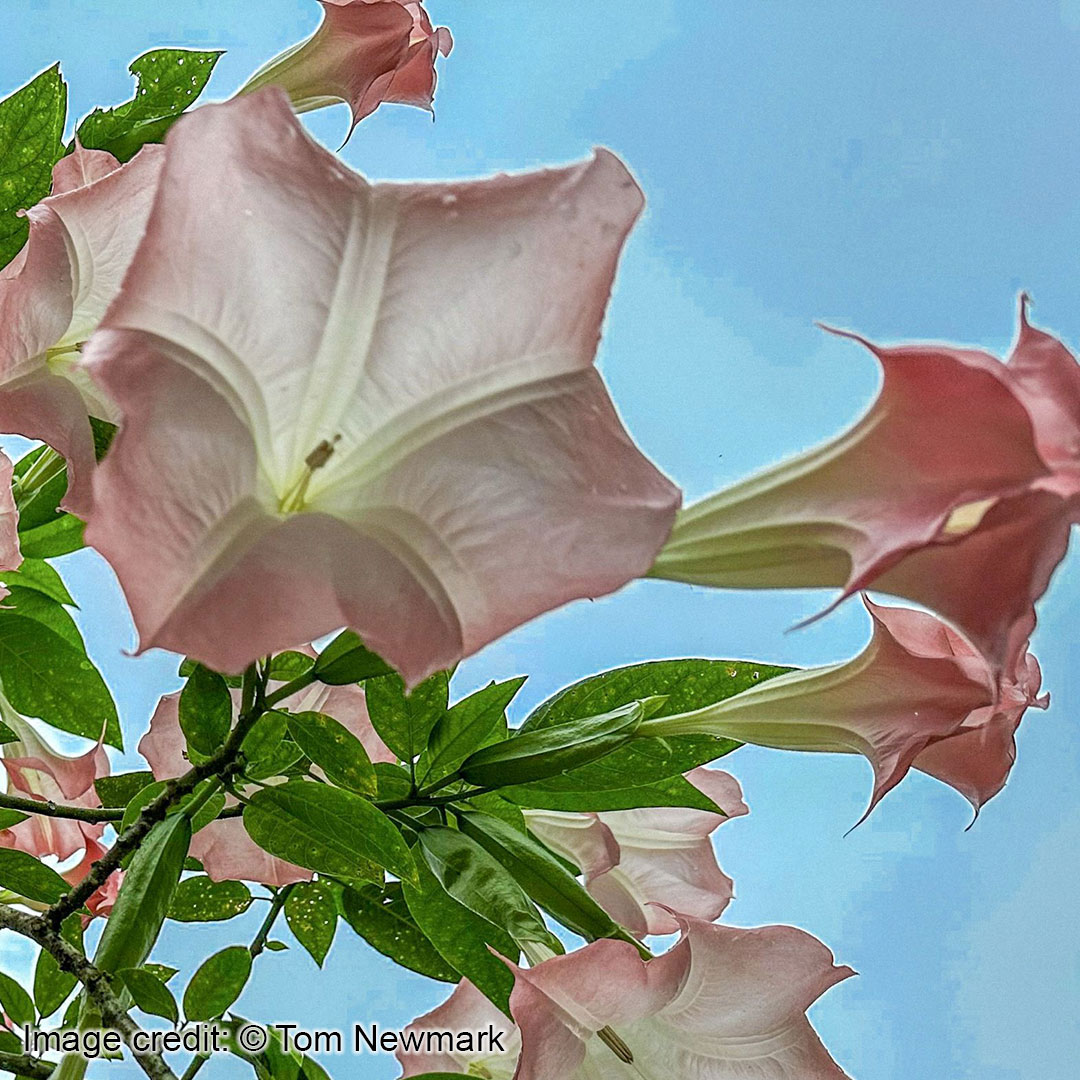
Angel’s trumpet (Brugmansia × candida) at Finca Luna Nueva Lodge, Costa Rica · Photo: Tom Newmark
Schrödinger’s cat presented a metaphysical riddle: it was, quantum mechanically, both dead and alive. Something like this can be said of the Brugmansia species featured here. It is extinct — evolutionarily dead — yet it is ubiquitous. It no longer is a part of the evolutionary dynamic of a living ecosystem, but it is a spectral presence in landscapes and human culture. It only exists because humans will it to exist, preserved as an evolutionary ghost yet so powerful that its involvement in the human experience can cause zombification, permanent psychosis, and death. Or contentment, pure joy, and lucid dreaming. It depends. And whether you live or die when interacting with this plant depends…
She is known in Costa Rica as Reina de la Noche — the Queen of the Night. In English she’s the Angel’s Trumpet. According to many indigenous cultures, she’s the Tree of the Evil Eagle, a constituent of mind-altering brews that to drink may lead to temporary or permanent insanity. Yeah, she might be the classic one-way ticket to Crazy Town. But she’s so soft and delicate, her angel-skin pink so pleasing to the eyes, her perfume so gentling, she is your friend, your muse — she must be safe. Gaze into her, take in her perfume, bring her to your nightstand, and… it depends.
Breakfast with a Zombie Nurse
Terry and I were having breakfast with guests one morning when we struck up a conversation with two gentlemen at a nearby table. We introduced ourselves, and I asked what had brought them to Finca Luna Nueva. One of the men explained that he had been a nurse at the Hôpital Albert Schweitzer in Haiti.
I asked, in a jocular tone, whether he’d ever treated any zombies.
He said yes. He was the nurse who had welcomed Clairvius Narcisse back to the living.
The room got quiet. Terry and I looked at each other. Having read Wade Davis’s extraordinary book The Serpent and the Rainbow, we both knew exactly who Clairvius Narcisse was. Davis’s account describes how Narcisse had been declared dead in 1962 at the Albert Schweitzer Hospital — signed off by two physicians, buried, and mourned. Eighteen years later, a man appeared in his village claiming to be Narcisse. He said he had been zombified: rendered into a death-like state by a potion, buried alive, then dug up and enslaved on a sugar plantation until his captor died.
The potion, Davis argued, was pharmacologically real. Its active components included tetrodotoxin from the puffer fish — one of the most potent neurotoxins known, capable of inducing paralysis so complete that victims are indistinguishable from the dead — combined with the psychoactive compounds in the secretions of the bufo toad (Rhinella marina), and tropane alkaloids from plants in the nightshade family. The same class of alkaloids found in Brugmansia.
We have bufo toads at Finca Luna Nueva. Quite a few of them, actually. We are, theoretically, one puffer fish bladder away from the capacity to make zombies.
We pledge never to do so.
Finca Luna Nueva’s founder, Steven Farrell, told us a story that drives the point home. A man Steven encountered in Costa Rica once decided it would be a good idea to place the flowers of the Reina de la Noche directly under his arms, reasoning that transdermal absorption through the thin skin of the armpit would deliver the plant’s psychoactive constituents more safely than ingestion. Steven reported that for several days thereafter this particular psychonaut was engaged in animated conversation with beings that no one else could see, entirely untethered from any reality Steven recognized. Whether that person ever fully found his way back to sanity, Steven could not say with certainty.
The armpit, it turns out, is an excellent transdermal delivery site. This is also, more or less, what the medieval witches knew.
The Chemistry of Flying
The tropane alkaloids in Brugmansia — scopolamine, atropine, and hyoscyamine — are among the most pharmacologically potent compounds produced by any plant on Earth. They are also among the most medically useful. Scopolamine, isolated in 1880 by German chemist Albert Ladenburg, appears today in the small transdermal patch worn behind the ear to prevent motion sickness. It is used in anesthesia. Atropine is on the World Health Organization’s list of essential medicines. Hyoscyamine treats gastrointestinal disorders. The chemicals that make this flower dangerous in large doses are the chemicals that make modern medicine possible in small ones.
The European witches understood delivery before pharmacologists had a word for it. Medieval flying ointments — documented by multiple independent sources in the sixteenth century, analyzed by Andreas de Laguna, physician to Pope Julius III — were made from belladonna, mandrake, henbane, and datura: all members of the nightshade family, all producing the same tropane alkaloids as Brugmansia. The fat in which these plants were rendered was not a filler. It was a transdermal delivery mechanism. Scopolamine is one of the very few plant alkaloids that can be absorbed directly through the skin, entering the bloodstream without the dangerous gastrointestinal route that made oral ingestion potentially fatal. Applied to thin skin or mucous membranes, the alkaloids produced vivid hallucinations: the sensation of flying, of traveling to distant places, of congress with spirits. The broomstick, historians now understand, was an intrauterine applicator.
Wade Davis describes Mexican sorcerers anointing their genitals, legs, and feet with datura-based salves and experiencing sensations of flight and light. The New World and the Old World arrived at the same chemistry by different routes, through different plants, with the same result. The alkaloids do not care which continent produced them.
Extinct in the Wild, Alive in the World
Here is the Schrödinger paradox at its sharpest: all seven species of Brugmansia are extinct in the wild. Every one. The IUCN has listed them as such since 2014. No wild population exists anywhere in their native range in the Andes and tropical South America. The angel’s trumpet survives only because humans have chosen to keep it — in gardens, in lodge grounds, outside bedroom windows, in the ethnobotanical collections of botanical gardens worldwide.
It is an evolutionary ghost sustained by human will. And yet it is everywhere — in Costa Rica, in gardens across the tropics, in windowsill pots in apartments in Paris and Berlin. More Brugmansia exist today than at any point in their evolutionary history. They are extinct and ubiquitous simultaneously. Schrödinger would have appreciated the irony.
The Moth and the Night
Terry and I planted our Brugmansia trees near our bedroom deliberately. The flowers open at dusk and release their fragrance into the night air with a generosity that is, frankly, difficult to believe is botanical in origin. It is more perfume than flower. Seductive in the precise meaning of that word: it leads you somewhere.
The intended audience is not human. Brugmansia flowers are pollinated primarily by bats and hawkmoths — both active at night, both drawn to that intensifying evening fragrance. The bats hover at the flower’s mouth and plunge their faces into the trumpet for nectar; the hawkmoths, sphinx moths of the family Sphingidae, hover with equal precision, their long tongues reaching deep into the corolla. During the day, stingless bees visit the flowers too — drinking nectar as secondary visitors, likely nectar thieves rather than effective pollinators given the depth of the trumpet. But the flower’s primary call goes out at dusk, to creatures of the night. The flower is not trying to please us. It is calling something else entirely. We are simply fortunate bystanders, breathing in a message that was never meant for us.
What it does to our dreaming is, we can confirm, real. The scopolamine in the air outside our window crosses the blood-brain barrier in trace amounts. It touches the same neurological mechanisms that make the plant dangerous in larger doses, and produces instead something gentler: vivid, luminous, navigable dreams. The Queen of the Night earns her name.
Reina de la Noche at Finca Luna Nueva
Our Brugmansia × candida trees grow near the lodge and along the garden paths, their flowers opening each evening into the Caribbean slope air. The blossoms begin creamy white and age over a day or two into the soft pink you see in the photograph above — shot from below, looking up into the throat of the flower, the blue Costa Rican sky visible beyond. It is, we think, the right angle for this plant: looking up into it, slightly overwhelmed, not entirely sure what you’re dealing with.
Approach her with appreciation. Breathe her in. Let the moths have their moment at the flower’s edge. And know that you are standing next to one of the most consequential plants in the history of human consciousness — a plant that has shaped shamanic traditions, informed European witchcraft, contributed to modern medicine, and may or may not be softening your dreams tonight.
Stop. Look up. Give yourself a moment. You came a long way for this, and it is worth every second.

