


MEET OUR SISTER SPECIES · No. 5
The Bird That Sings for Rain
April 20, 2026
Posted by: Tom Newmark
Clay-Colored Thrush: Yigüirro Turdus grayi
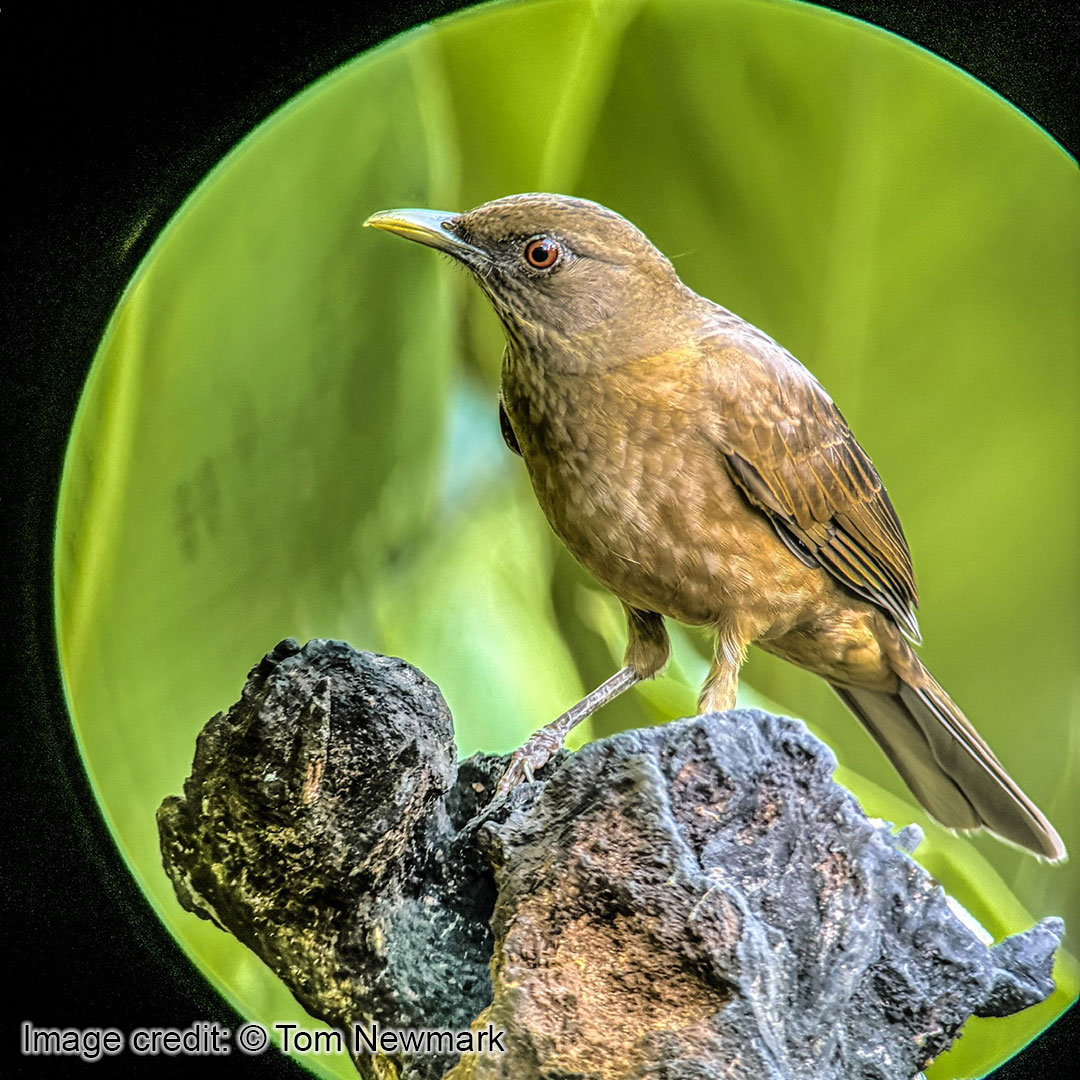
Clay-colored thrush ( Turdus grayi ) photographed through a spotting scope — Finca Luna Nueva Lodge, Costa Rica · Photo: Tom Newmark
Costa Rica is home to more than 900 bird species. The Resplendent Quetzal shimmers in the cloud forest like a jewel with wings. The Lovely Cotinga wears sapphire blue and a purple bib. Scarlet Macaws light up the canopy like something a child drew. And yet, in 1977, Costa Ricans looked at all of that chromatic extravagance and chose as their national bird a small, plainly dressed thrush the color of wet clay.
Its scientific name is Turdus grayi. Yes, that genus. The species name honors British zoologist John Edward Gray — a distinction that has surely delighted ornithologists and embarrassed no one more than the bird itself.
The yigüirro, as Costa Ricans call it with obvious affection, is not flashy. It is not spectacular. It is not the bird you photograph first. It is, however, the bird you hear every morning. And that, it turns out, is exactly the point.
Quick Facts:
Clay-Colored Thrush
| Scientific name: | Turdus grayi |
| Local name: | Yigüirro — Costa Rica’s name, derived from indigenous languages |
| Family: | Turdidae (thrushes) |
| Length: | 23–27 cm (9–10.5 in) |
| Weight: | 74–76 g |
| Plumage: | Uniform warm brown; paler underparts; yellowish-green bill; amber eye-ring |
| Range: | South Texas to northern Colombia; year-round in Costa Rica |
| Habitat: | Gardens, farms, forest edge, towns — wherever people live |
| Diet: | Fruit, earthworms, insects, invertebrates |
| Song: | Varied, melodious, long-sustained — described as caroling with slurred whistles and warbles |
| Status: | Least Concern (IUCN) — one of Costa Rica’s most common birds |
| National bird since: | January 1977 |
Why This Bird? Why Not That One?
In a country where the Lovely Cotinga exists — a bird that looks like someone spilled a paint palette in the forest canopy — choosing the clay-colored thrush as a national symbol requires an explanation. Costa Ricans had one, and it is quietly profound.
The yigüirro sings most intensely at the start of the rainy season. For generations of Costa Rican farmers, its caroling was the signal: the rains are coming. Plant now. Get ready. In an agricultural nation whose life has always depended on the rhythm of wet and dry, a bird that announces the rain is not humble. It is essential.
There is also something democratic about the choice. The Resplendent Quetzal lives in remote cloud forests; spotting one requires effort, altitude, and luck. The yigüirro lives in your garden. It hops across your patio. It nests under your eaves. It is mentioned in folk songs, short stories, and novels precisely because it has always been there, part of the daily texture of Costa Rican life. The national bird, Costa Ricans decided, should be everyone’s bird — not just those with binoculars and a four-wheel drive.
Birder Adjacent
Terry and I are not expert birders. We say we’re “birder adjacent.” We can’t pull 300 species from memory by their songs alone. We watch with genuine wonder what the gifted independent guides who work with us can do — identifying a distant call in a fraction of a second, placing it instantly on the right branch of the right tree. It is a kind of fluency we admire but don’t possess.
What this means in practice is that when we hear birdsong and we can’t immediately identify it, we default. “Must be the yigüirro,” one of us says.
And we are often right. That is the yigüirro’s other great distinction: it sings constantly, varied and mellifluous, from before dawn until the day closes. Naturalist Alexander Skutch described it as “a long-continued caroling of varied phrases, mostly rich and melodious, containing slurred whistles, warbles, short trills, and now and then dry, piercing notes.” The yigüirro is everywhere, singing everything. Even birder-adjacent people get it right.
What Does a Yigüirro See?
Here is where the story of this apparently plain bird becomes genuinely astonishing.
When you look at a clay-colored thrush, you see warm brown. Earthy. Understated. The yellowish bill is the one field mark that catches the eye, and even that is modest. You might be forgiven for thinking this is simply a bird that drew the short straw in the great lottery of avian plumage.
But you are not a clay-colored thrush. And a clay-colored thrush is not looking at the world through your eyes.
Birds are tetrachromats. Where humans have three types of cone cells in our retinas — sensitive to red, green, and blue — birds have four. That fourth cone type is sensitive to ultraviolet light, a wavelength entirely invisible to the human eye. Birds don’t just see more colors than we do. They see a whole dimension of color that we cannot access, cannot imagine, and cannot describe, because we have no words for colors we have never seen.
Think of it this way. A person who has been colorblind from birth and has never seen red cannot truly understand what red looks like, no matter how carefully you explain it. You can say “warm,” “fiery,” “like the feeling of heat made visible” — but the color itself remains inaccessible. That is precisely our situation with ultraviolet. We are colorblind, compared to every bird on Earth.
Researchers have photographed birds in ultraviolet light and discovered that species appearing uniform and drab to human eyes are anything but. Feathers that look identical in visible light blaze with UV patterns — markings that signal health, dominance, and genetic quality to other birds. The clay-colored thrush that looks plain brown to you may appear to another yigüirro as a creature wearing an invisible kaleidoscope. Shimmering patterns we will never see. Colors that have no names.
The oil droplets in avian cone cells act as precision light filters, sharpening color discrimination far beyond what our eyes can manage. Birds can distinguish between shades of color that appear completely identical to us. When a female yigüirro chooses a mate, she is evaluating him in four dimensions of color. We watch what appears to us to be two brown birds on a branch.
The Yigüirro at Finca Luna Nueva
The yigüirro is at home here in the way that only the most adaptable, most confident species can be. It moves through our farm’s gardens, fruiting trees, and forest edges without ceremony, as if it owns the place. It was here before the lodge was built. It will be here after.
Every morning, high above the valley, where the Río Chachagua runs below and the mist still clings to the forest, it begins. That long, varied caroling — the one that Costa Rican farmers have trusted for generations to tell them when to plant, when to prepare, when the rains are on their way. It is not a dramatic bird. It is not the bird your eyes go to first when you step outside.
But close your eyes. Listen. That song, rolling and varied and wholly unhurried, is the sound of a creature at absolute ease in its own landscape. And somewhere in those notes, in frequencies your ears can hear but in colors your eyes will never see, it is also something more: a bird that has always known exactly who it is.
Come and Listen
You do not need to be a birder to appreciate the yigüirro. You do not need a field guide or binoculars or a lifetime of accumulated species names. You need only to sit still for a moment in the morning, at Finca Luna Nueva, and let the song come to you.
Some birds inspire field guides. Some inspire wonder. The yigüirro inspires both — and then quietly reminds you that the most ordinary things, seen rightly, are never ordinary at all.
Stop. Look up. Give yourself a moment. You came a long way for this, and it is worth every second.

