


MEET OUR SISTER SPECIES · No. 9
The Little Things that Run the World
May 18, 2026
Posted by: Tom Newmark
Leafcutter Ant (Zompopa): Atta cephalotes
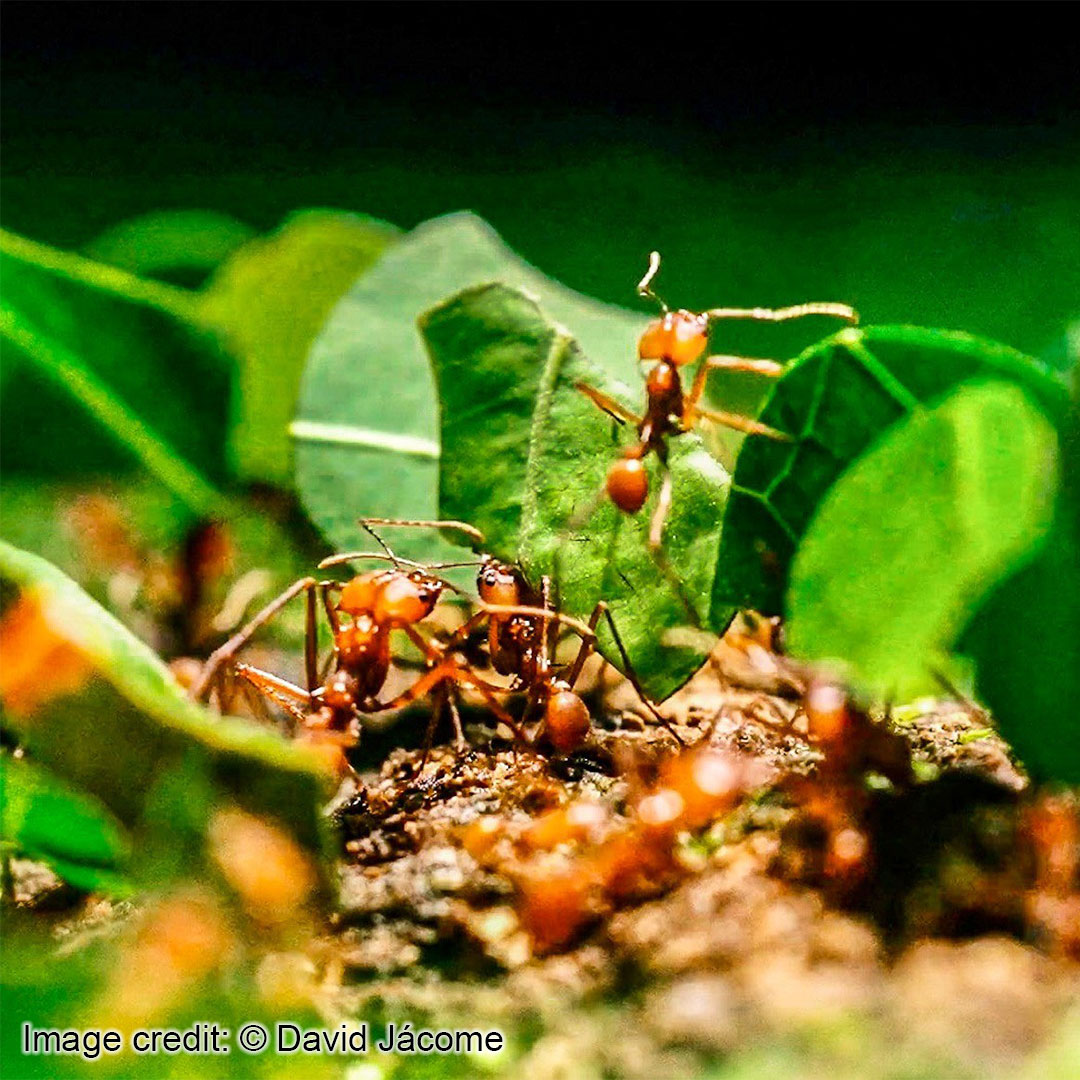
Leafcutter ants (Atta cephalotes) at Finca Luna Nueva Lodge · Photo: David Jácome
Let me start with an apology to all leafcutter ants: I should have started with you. I was distracted by other species’ flashy colors or sweet flavors, but all along it was you. You are the keystone: all life here in the Central American rainforest depends on you, and you deserved pride of place in my Sister Species series. You were here long before humans emerged and you’ll hopefully survive the damage we’re wreaking on the planet.
They Are Not Eating the Leaves
Here is the thing that stops most people: the leafcutter ant (Atta cephalotes) does not eat leaves. It never has. The workers cut and carry leaf fragments not for food but for raw material — substrate for the fungus garden that occupies the deepest chambers of the colony. Underground, a dedicated caste of smaller workers chews the leaf pulp into a spongy mass, inoculates it with fungal threads, and tends the resulting garden with extraordinary precision, weeding out competing organisms, monitoring moisture and temperature, harvesting the nutritious fungal nodules that are the colony’s actual food.
The fungus is Leucoagaricus gongylophorus. It does not exist anywhere in the wild outside of leafcutter ant colonies. The ants cultivate it; the fungus feeds the ants; neither can survive without the other. This relationship began approximately 50 million years ago — making the leafcutter ant the world’s oldest farmer by a margin that makes human agriculture look like a blip on the timeline of evolution. The domestication process — the gradual, evolutionarily driven transformation of a wild fungus into a captive crop — took 30 million years to complete. The result is a fungus that no longer produces spores. It has surrendered its independent reproductive capacity entirely. It cannot spread without the ants. It is, in the most literal biological sense, domesticated.
Every leafcutter colony in the Americas carries a strain of L. gongylophorus that may be a clonal descendant of a single ancestral population. When a new queen leaves her natal colony to found her own, she carries a tiny pellet of fungal mycelium in a specialized pouch inside her mouth. She does not look for a new fungus. She brings the family strain. She has been doing this, in an unbroken chain of maternal transmission, for tens of millions of years. The fungus is not just domesticated. It is heirloom.
The Superorganism — and She Is a She
The biologists E.O. Wilson and Bert Hölldobler, who spent their careers studying social insects, argued that a leafcutter colony is best understood not as a collection of individuals but as a single organism — a superorganism, in which the colony itself is the unit of biology, and the individual ant is more analogous to a cell than to an animal. The queen is the reproductive organ. The soldiers are the immune system. The foragers are the sensory and metabolic systems. The fungus garden is the gut.
You would not introduce yourself to one ant any more than you would single out a single cell on your friend’s hand for a morning greeting. The colony is the entity. She is more like a singular body than a dance troupe.
And she is, emphatically, a she. Every worker in the colony — every forager, every soldier, every gardener, every minim riding shotgun on a leaf fragment, every road-maintenance crew member — is female. The colony is an all-female society. Males exist, but their role is brief in the colony’s timeline — they are produced seasonally for the nuptial flight, the aerial mating swarm in which virgin queens and males take to the air. The males mate. Then they die. They never return to the nest, never forage, never defend anything. Their entire biological purpose is accomplished in a single flight. After that, the colony has no further use for them.
The new queen stores enough sperm to fertilize eggs for the rest of her life — which may span 10 to 20 years — then falls to earth, sheds her wings, and begins. From that moment on, everything you see on that trail is female. She rules.
A mature Atta cephalotes colony may contain eight million workers across as many as a dozen distinct castes, each specialized to a task the others cannot perform. The mid-sized workers do the cutting and carrying. The smallest, called minims, ride atop the leaf fragments being carried, defending against parasitic flies that would otherwise lay eggs on the exposed workers. And then there are the soldiers.
A local guide once held a soldier leafcutter ant and enticed it to bite a machete. The blade sang. The mandibles of a major soldier — the largest caste, with a head nearly as wide as a human thumbnail — are among the most powerful cutting instruments in the insect world, proportionally capable of forces that would shear through material many times harder than leaf. The machete did not yield. But ultimately the rainforest yields to her management. She has been managing it for 50 million years.
Wilson and Hölldobler observed that the principle driving the emergence of superorganisms — intergroup competition forcing intragroup cooperation — is the same force that drives the emergence of cooperation at every level of biology, from genes within a genome to cells within a body to individuals within a society. The leafcutter is not an exception to the rules of life. It is one of the clearest demonstrations of them.
The Numbers Behind the Dance
Consider what 12 to 17 percent means. Research across neotropical rainforests consistently finds that leafcutter ants harvest between 12 and 17 percent of total annual leaf production in their foraging territory — reaching into 50 percent of all plant species present. A single mature colony collects upward of 300 kilograms of plant material in a year.
All of that biomass goes underground. The fungus processes it, the ants consume the fungus, the waste goes to refuse chambers, the refuse chambers become some of the most microbiologically active soil in the ecosystem. Leafcutter ants are not mining the rainforest. They are cycling it. The leaves come down from the canopy, pass through eight million workers and one ancient fungal cultivar, and return to the earth as something richer than what they were. In a very real sense, every gram of that harvested canopy is a deposit in the soil bank.
Consider too what this means for soil fertility. The tropical rainforest is a place of furious biological activity — organic matter deposited on or in the soil is consumed, broken down, and recycled by decomposers with extraordinary speed. In many tropical ecosystems, a fallen leaf is gone within weeks. The forces of decomposition are so powerful that soil fertility can be stripped as fast as it is built. This is the paradox at the heart of the rainforest: extraordinary biological richness sustained on soils that are perpetually on the edge of exhaustion. What keeps the balance? In no small part, her. The continuous underground delivery of fresh organic matter by leafcutter colonies — leaf pulp, spent fungal gardens, refuse, the accumulated chemistry of millions of workers — replenishes what decomposition removes. She is not disrupting the nutrient cycle. She is the nutrient cycle. Balance and fertility are maintained, in this rainforest and across the neotropics, by her endless, tireless, fifty-million-year labor.
The Engineers
The cultivation of Leucoagaricus gongylophorus is not a casual operation. The fungus requires a narrow temperature band to thrive — too warm and it dies, too cool and it stalls. Maintaining that band inside a mound that may sit in tropical heat is an engineering problem of the first order. The colony solved it 50 million years ago.
The solution is a central debris chamber into which organic waste from the fungus garden is continuously discarded. The decomposition of that waste generates heat — controlled, predictable, biological heat. Vents connect this central chamber to the surface, and the rising warm air draws cooler air in through secondary air shafts, creating a convective loop that regulates the temperature of the fungal gardens with remarkable precision. The colony built air conditioning before the concept of engineering existed.
The nest itself may extend six meters deep and occupy 30 cubic meters of excavated earth, with over a thousand chambers of varying size, each serving a specific function: fungal gardens, brood chambers, the queen’s chamber, refuse disposal, ventilation. The whole structure is a feat of passive climate control that modern architects study seriously. Termite mounds have received more publicity for this trick, but the leafcutter ant was doing it first, and doing it at greater scale.
The Pharmaceutical Laboratory
She is not just a farmer and an engineer. She is also a pharmacist — and she has been practicing pharmacy for roughly as long as she has been farming.
The fungus garden faces a mortal threat: Escovopsis, a specialized parasitic fungus that evolved alongside the ant-fungus relationship 55 to 60 million years ago. Escovopsis does not attack the ants directly. It attacks the crop. Left unchecked, it can overwhelm the garden and bring down the entire colony. Her food supply, her larvae, her queen, eight million lives — all of it vulnerable to a fungal pathogen that has had tens of millions of years to perfect its assault.
The colony’s response is one of the most sophisticated biological defense systems ever discovered. Each worker carries on her cuticle — her exoskeleton — a living coat of Pseudonocardia bacteria, actinobacteria cultured in specialized crypts and glands on the ant’s body surface. These bacteria produce antifungal antibiotics, including compounds chemically similar to nystatin, one of the most important antifungal medicines in human pharmacology. The ants do not manufacture the antibiotics themselves. They cultivate the bacteria that do. They are not just farmers. They are antibiotic manufacturers — culturing a microbe to produce a drug to protect a crop.
This is a five-species symbiosis: the ant, the food fungus, the Pseudonocardia bacteria, the parasitic Escovopsis, and the arms race between all of them. Escovopsis has evolved chemical weapons specifically to disable the Pseudonocardia defense — compounds that suppress the antibiotic bacteria and, in high doses, are lethal to the ants themselves. The bacteria have evolved to counter. The parasite counters back. The evolutionary arms race has been running for 50 million years, and shows no sign of resolution.
When humans discovered antibiotics in the twentieth century, we thought we had invented something new. The leafcutter ant would like a word. She had been farming, engineering climate control, and manufacturing antibiotics long before the first hominid stood upright. The colony is not just a superorganism. It is a Silicon Valley of high-tech ant-repreneurs. E.O. Wilson once called insects “the little things that run the world.” She is his proof.
The Prima Ballerina
The term keystone species — coined by ecologist Robert Paine in 1969 after observing how the removal of a single predator starfish collapsed an entire tidal community — describes an organism whose effect on its ecosystem is disproportionately large relative to its abundance. Remove the keystone and the arch falls. Not gradually. Suddenly.
The leafcutter qualifies more completely than almost any other organism in this ecosystem. She is the dominant herbivore, processing more vegetation than any other animal group in the neotropical rainforest. She is a soil engineer, whose tunnels aerate the earth, channel rainfall, and concentrate nutrients at depth. She is a diversity regulator, preferentially targeting dominant plant species and thereby creating the light and space in which slower-growing plants establish — maintaining the mosaic of species that defines a healthy forest rather than a monoculture of competitive winners. Her refuse chambers host microbial communities of extraordinary richness.
If humans disappeared from this rainforest tomorrow, the ecosystem would probably dance a jig. The forest knows how to live without us — it did so for millions of years before we arrived and will do so again if we depart. But if the leafcutter disappeared, the party is over. Turn out the lights. The soil stops turning. The canopy closes in. The diversity collapses inward. The other organisms that depend on the disturbance she creates — the plants that need the light gaps, the microbes that need the refuse chambers, the species that need the aerated soil — all of them feel it. There is no ecological understudy for the zompopa.
Our Most Challenging Sister Species
We know a keystone species when we see one, and we see her. We respect her. But she is a beast! A mature zompopa colony can rapidly and thoroughly defoliate trees and garden plants. A colony targeting the cacao grove or the herb garden can do devastating damage in a single night — and once established, a colony is genuinely difficult to control. As a regenerative and organic farm, we do not use synthetic pesticides. Which leaves us with a challenge that is as philosophical as it is practical.
Our philosophy begins with sharing. We are comfortable tithing a fair portion of our produce to the creatures with whom we share this land — that is part of what it means to farm regeneratively rather than extractively. But she is blind to our farming concerns, and deciding what constitutes a just portion is a particular challenge with a species that does not negotiate and does not stop.
Our farm manager, Gerardo Calderón — who trained directly in the syntropic tradition and who is a committed vegan — brings his own considered position to the discussion. He is, to put it gently, resistant to control measures he deems violent toward other living organisms. This is a genuinely held philosophical position, and we respect it.
Recently I put our management dilemma to a leader in the syntropic farming movement. His response was direct: “You are not growing ants. You are growing food. You are not applying pesticides to food, so you have got to do what you can to protect the yields. Even if that means applying poison to a leafcutter colony, much as you would apply poison to a termite colony threatening your home.”
I relayed this to Gerardo. He thought about it for a moment and said: “Yes. But we are growing soil.”
He is not wrong. And neither is the syntropic consultant. We are still working out where the truth lives between those two positions. We will let you know when we figure it out.
What They Give Back
What the leafcutter takes from the farm she returns, in ways that are not always visible. The fungus gardens, when a colony eventually abandons a chamber, decompose into extraordinarily rich organic matter. The tunnel systems aerate compacted soil and channel rainfall deep into the earth. And the foraging pressure that seems destructive from the perspective of a single plant is, at the ecosystem scale, part of the process that maintains plant diversity — she preferentially targets dominant species, giving slower-growing plants the light and space they need to establish.
The leafcutter ant is one of the primary reasons that the soils of the neotropical rainforest are as biologically active as they are. The underground fungus gardens generate heat, moisture, and chemistry that support microbial communities far beyond the boundaries of the nest. In a very real sense, the zompopa is not just a farmer. She is a soil builder. She was building soil here for 50 million years before Gerardo or I had opinions about how to do it. To her, we bow down.
Quick Facts:
Leafcutter Ant (Zompopa)
| Species: | Atta cephalotes |
| Common name: | Leafcutter ant | Zompopa (Costa Rica) |
| Colony size: | Up to 8 million workers; up to 12 castes |
| Farming age: | ~55–60 million years — the world’s oldest agricultural system |
| Crop: | Leucoagaricus gongylophorus (fungus, fully domesticated ~15 million years ago) |
| Annual harvest: | 12–17% of leaf production in foraging territory |
| Soil turnover: | A single colony may move 40,000 kg of soil over its lifetime |
| Range: | Southern Mexico to northern Argentina; throughout Costa Rica |
| Status at FLN: | Resident — actively (and as of now inadequately) managed with organic methods |
Stop. Look up. Give yourself a moment. You came a long way for this, and it is worth every second.

