


MEET OUR SISTER SPECIES · No. 4
The Tree That Survived the Conquistadors
April 13, 2026
Posted by: Tom Newmark
Pejibaye: Bactris gasipaes
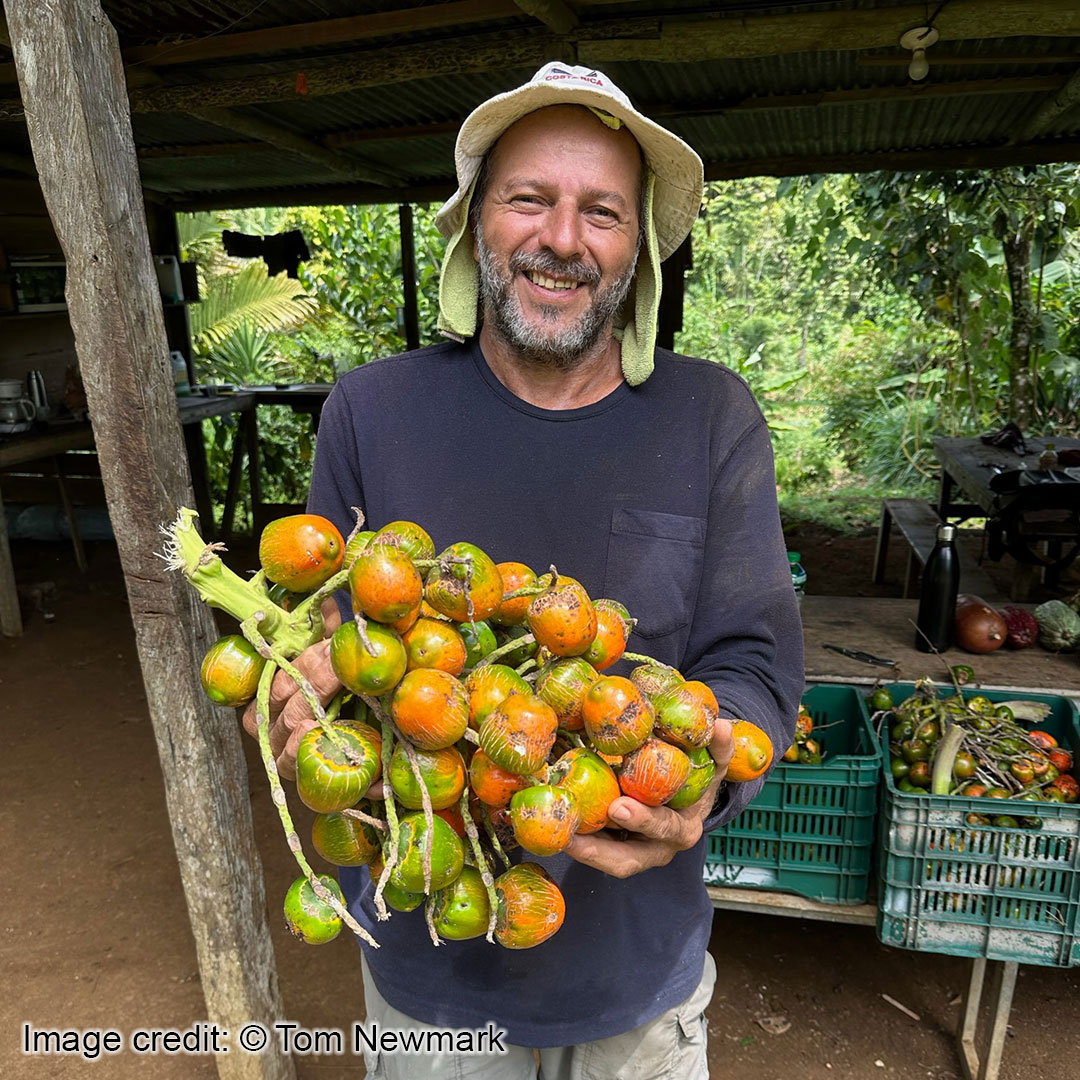
Walter Arias, senior member of the Finca Luna Nueva farm crew, with a fresh-harvested racimo of pejibaye ( Bactris gasipaes ) — Finca Luna Nueva Lodge, Costa Rica · Photo: Tom Newmark
There is a reason Walter is smiling. That cluster of orange and green fruit he’s holding — a full racimo of pejibaye, or peach palm — represents something much older and more remarkable than a farm harvest. It represents survival. Four thousand years of it.
The pejibaye palm ( Bactris gasipaes ) arrived in Costa Rica’s Caribbean slope from the Amazon basin, carried northward by indigenous peoples who understood, long before the concept of a superfood existed, that this spiny, prolific, generous tree was something close to irreplaceable. Archaeological evidence places cultivated pejibaye in Costa Rica as early as 2300 BC. It fed generations. It shaped cultures. And when the Spanish came and tried to destroy it, it refused to disappear.
At Finca Luna Nueva, the pejibaye is not a relic. It is a living, fruiting, flourishing member of our regenerative farm — feeding our guests at the table, feeding our chickens in the field, and feeding the birds that pass through our canopy. Some things earn their place over centuries. The pejibaye has earned it over millennia.
Quick Facts:
Pejibaye
| Scientific name: | Bactris gasipaes |
| Family: | Arecaceae (palm family) |
| Height: | Up to 20 meters (65 ft); clumping, multi-stemmed |
| Origin: | Amazonian lowlands; domesticated 4,000–3,000 years ago |
| Arrival in Costa Rica: | Archaeological evidence dates to approximately 2300 BC |
| Fruit: | Dense clusters of 50–300 fruits; orange, red, or yellow; must be cooked |
| Flavor: | Earthy, nutty, faintly sweet — somewhere between chestnut, pumpkin, and potato |
| Nutrition: | Rich in complex carbohydrates, healthy fats, vitamins A, B1, B2, B3, C; calcium, phosphorus, iron |
| Also harvested for: | Heart of palm — Costa Rica is the world’s leading exporter |
| Lifespan: | Productive for 50–75 years |
| At FLN: | Multiple mature trees; fruit served at the lodge table and fed to the hens in the movable enclosure |
A Taste Unlike Anything Else
Ask someone to describe the flavor of pejibaye and they’ll pause. It doesn’t map neatly onto anything familiar. The closest approximation: imagine a chestnut and a pumpkin had a child, raised it on rich volcanic soil, and fed it nothing but healthy fats and complex carbohydrates. Dense, earthy, faintly sweet, slightly nutty — with a richness that lingers. The texture is starchy and firm, somewhere between a boiled potato and a dry squash.
It is not subtle. It is not delicate. It is exactly the kind of flavor that makes you understand why a civilization built itself around a tree.
In Costa Rica, pejibaye is everywhere: roadside stands, city markets, supermarket deli counters, farm kitchens. The traditional preparation is simple — boiled in salted water for an hour or more until the dense flesh softens, then halved, pitted, and eaten with a small spoonful of mayonnaise or sour cream, both of which complement it perfectly. At Finca Luna Nueva, our kitchen finds its own ways to honor it — in soups, in purées, and straight from the farm to the table.
The Nutrition of a Survival Food
Indigenous peoples of Amazonia and the Caribbean slope did not call pejibaye a superfood. They called it dinner. And breakfast. And the thing you planted before everything else, because a productive tree would feed your family for fifty years.
The science behind that instinct is now well documented. Pejibaye is rich in complex carbohydrates for sustained energy, and its fat profile is dominated by oleic acid — the same heart-healthy monounsaturated fat found in olive oil. It delivers vitamins A, B1, B2, B3, and C, along with calcium, phosphorus, and iron. One Spanish chronicler in 1575 wrote that among the indigenous peoples of Costa Rica, only their wives and children were held in higher regard than this palm.
The birds know it too. Wildlife throughout our farm — from parrots to toucans to the smaller canopy species — moves through the pejibaye trees when the fruit ripens. What sustained human civilizations for thousands of years turns out to be equally persuasive to the rest of the rainforest.
What the Spanish Tried to Erase
During the Spanish colonization of Costa Rica, colonizers found a pejibaye plantation of 30,000 trees on the Caribbean coast — a managed, intentional food forest that had been feeding indigenous communities for generations. Their response was systematic. They cut down 20,000 of those trees.
The logic was brutal and deliberate: destroy the food supply, break the people. Starve out the resistance. It was a strategy applied across the Americas wherever colonizers encountered indigenous communities with deep agricultural roots. Attack what feeds them.
It didn’t work. The pejibaye survived. It always does. It suckers freely from its base — cut one stem and others replace it. It grows rapidly, up to two meters per year. It fruits for half a century. The tree that indigenous peoples of Amazonia carried across thousands of miles and thousands of years could not be erased by axes.
After the conquest, pejibaye became a neglected crop — its cultural centrality diminished, its grandeur overlooked by the European palate. But it never disappeared from the Caribbean slope. It persisted in farm edges, in forest clearings, in the gardens of families who remembered what it meant. And today it is coming back — honored again, studied for its nutritional density, cultivated in agroforestry systems exactly as the Amerindians designed it to be grown.
Pejibaye at Finca Luna Nueva
Our farm sits precisely in the heart of traditional pejibaye territory — the Caribbean slope, the humid lowland forest that this palm has called home for four millennia. The trees grow well here, fruiting generously in clusters that can weigh 25 pounds or more. Walter and the farm crew harvest them when the skins shift from green to that characteristic blaze of orange and red.
The fruit goes in two directions: to the kitchen, where it appears in soups and farm-to-table preparations, and to the movable chicken enclosure, where our hens treat it as the luxury item it is. Happy hens, it turns out, have the same taste in fruit as the peoples who planted these trees four thousand years ago.
And the tree gives more than fruit. The heart of palm — harvested from young stems — is one of Costa Rica’s most prized culinary exports. A single pejibaye clump produces both, season after season, for decades. In a regenerative farming system that values longevity, biodiversity, and reciprocity with the land, it is close to the ideal plant.
Come and Taste Four Thousand Years
There is a particular pleasure in eating something with that much history behind it. The flavor alone is worth the conversation — that earthy, nutty, chestnut-pumpkin richness that no other fruit quite resembles. But knowing that you are eating what indigenous Amazonians carried across a continent, what Spanish colonizers tried to destroy and failed, what Walter harvested this morning from trees that will still be fruiting long after all of us have moved on — that makes it taste even better.
Some plants are ingredients. This one is a story.
Stop. Look up. Give yourself a moment. You came a long way for this, and it is worth every second.

