


MEET OUR SISTER SPECIES · No. 10
Theobroma Cacao: Food of the Gods
May 25, 2026
Posted by: Tom Newmark
Cacao: Theobroma cacao
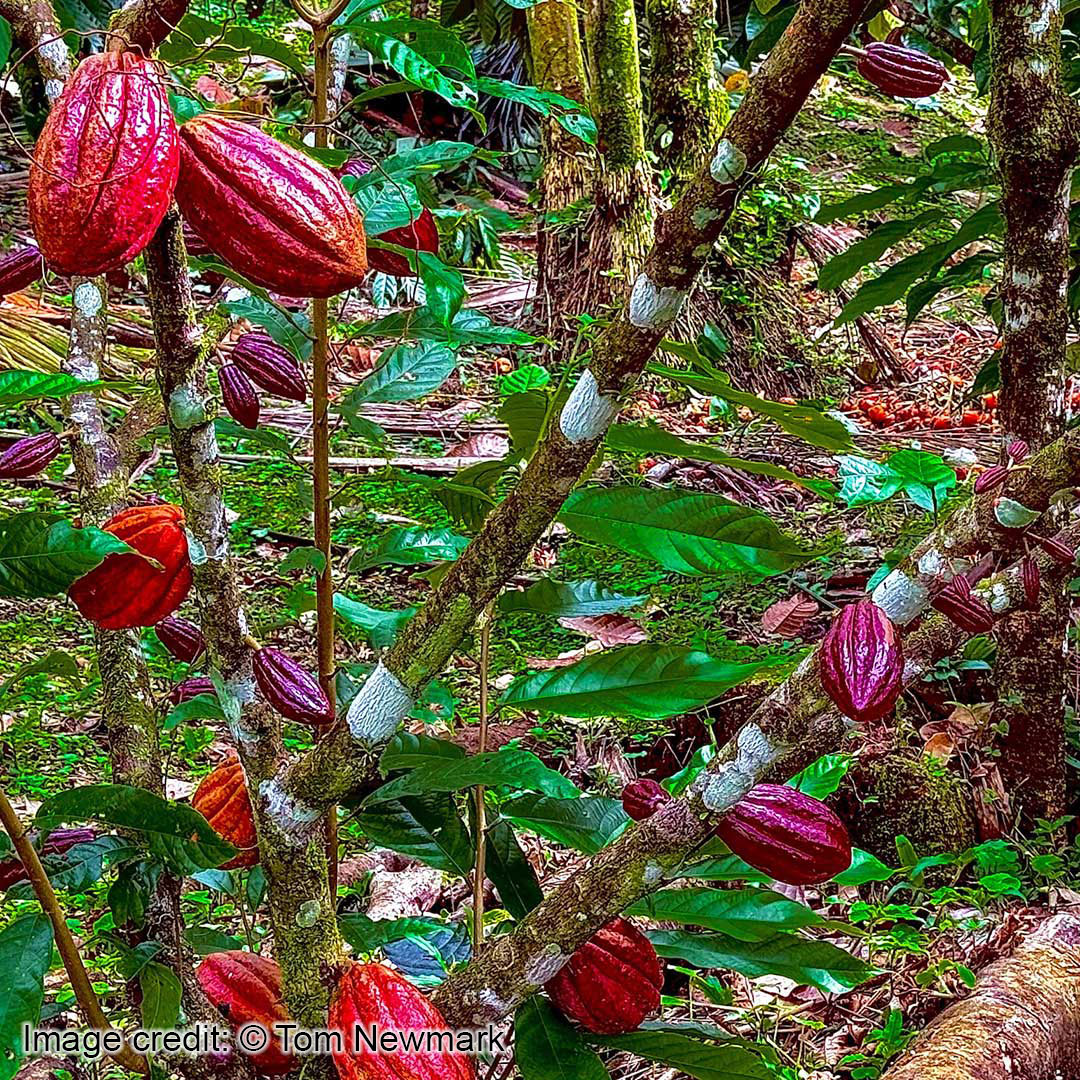
Estate cacao grove at Finca Luna Nueva Lodge, Caribbean slope, Costa Rica · Photo: Tom Newmark
When you entered the Cabalonga Trail you set your watch back five million years. This is the great Atlantic primary rainforest, and to the soundtrack of howler monkeys and toucans you hiked up and down the hillside of the Río Chachagua valley and felt the primeval power. Now you’re back at the lodge, and you settle down at the black bamboo bar in the Moondrops Lounge and decide you’ve earned a treat.
“Elizabeth,” you say, “I’d like something special. Something cold and sweet, made with sacred fruits and spices and suffused with the terroir of the rainforest. Something that will energize me and yet gift me with tranquility.” Sounds like something you’d want, right? And Ellie — you’re closer friends now — says: “Let me make you a Cosmic Cacao.”
That is the drink at Finca Luna Nueva Lodge. It uses the climax crop of our first syntropic field — estate-grown Theobroma cacao, harvested and processed by people who know these trees the way musicians know their instruments. We’ve had scientists studying the soils in our cacao grove, we offer tours of our farming methods, our guests make cacao preparations both ancient and modern, and our farm-to-table restaurant offers desserts crafted from our nibs and powders. Why are we so focused on cacao? Turns out, we are late to the party. Indigenous peoples of the western hemisphere have been working with cacao for thousands of years, and from the time of the Spanish conquest onward the whole world has developed an almost insatiable appetite for it.
Theobroma cacao. The Food of the Gods. Let us tell you its story.
Born in the Upper Amazon
The story begins in what is now southeastern Ecuador, in a place called Santa Ana-La Florida in the Zamora Chinchipe province, where the foothills of the Andes slope down into the upper Amazon basin. Archaeological evidence — starch grains, ancient DNA, and theobromine residues in pottery — places human use of cacao here at least 5,300 years ago. This is the oldest confirmed domestication of Theobroma cacao anywhere on Earth. The greatest genetic diversity of wild cacao still exists in this region, in the river valleys near the Colombia-Ecuador border, which is the clearest signal botanists have that this is where the species emerged.
From the upper Amazon, cacao radiated north. How exactly remains one of the more intriguing puzzles in archaeobotany — overland through the forests of Colombia and Panama, or by sea along the Pacific coast in the canoes of pre-Columbian traders who navigated 4,000 kilometers of coastline over thousands of years of contact. Most likely both. By the time of the Olmec civilization in what is now southern Mexico, around 1500 BCE, cacao was already established as a cultivated crop and a sacred substance.
Cacao is not native to Costa Rica — no more than pejibaye or coconuts are native. But it has been here long enough to become woven into the ecosystem. We have a stone metate — a cacao grinding stone — found near our farm and thought to be approximately a thousand years old. Someone in this valley was processing cacao in the region of the Río Chachagua long before there was a lodge, a road, or a name for this place in any European language. The cacao grove we farm today is, in some sense, a continuation of something very old.
The Drink of the Gods
The Maya called it chocolhaa — “bitter water.” The Aztecs called it xocolatl. From those words, eventually, came “chocolate.” But the drink those words described bore almost no resemblance to what most people today call chocolate. It was bitter, frothy, spiced with chili and vanilla, sometimes colored red with annatto — the same spice used in our Drink of the Gods recipe to this day — and it was consumed cold. The foam, generated by pouring the liquid from height between vessels, was considered the best part.
Cacao was not merely food. It was currency, medicine, and sacrament simultaneously. One hundred cacao beans could buy a turkey. It’s truly horrifying to learn that an enslaved person could also be purchased for about a hundred beans. Cacao pods appear in Maya creation stories; the Maya city of Palanque carved its queen reborn as a cacao tree. The Aztec emperor Montezuma II reputedly consumed more than fifty cups of xocolatl per day, served in golden vessels. Cacao was offered to the gods, included in burial goods, consumed at marriages, births, and military campaigns. It was, in every sense, the axis around which Mesoamerican civilization turned.
The drink was prepared with knowledge and ceremony: beans fermented, dried, roasted, and ground on a stone metate — exactly the kind of stone found near our farm — into a paste, then mixed with water and spices and poured back and forth until it foamed. No sugar. No milk. No sweetness. Pure, complex, bitter, alive.
The Conquest and the Confection
In 1519, Hernán Cortés arrived in Mexico, was received by Montezuma, and observed xocolatl at the Aztec court. He wrote to King Carlos I of Spain describing it as “a drink that builds up resistance and fights fatigue” — useful intelligence for an army of conquest. Within two years he had destroyed Tenochtitlán, dismantled the Aztec civilization, and sent its gold back to Spain. He took the cacao, too. The people who had cultivated and consecrated it for millennia were gone. The plant survived.
Whether Cortés personally carried cacao to Spain is historically contested — Dominican friars who brought Mayan nobles to the Spanish court in 1544 may have been the actual vectors. But whoever carried it, the trajectory was the same: the sacred bitter drink of Mesoamerica arrived in Europe, was found unpalatable by Spanish tastes, and was transformed. Sugar — arriving in Europe from Southeast Asia at roughly the same moment — was added. Then cinnamon. Then vanilla. Then milk. The bitter drink of the gods became a sweet luxury of the European aristocracy, jealously guarded by Spain for nearly a century before spreading across the continent.
The final transformation came in 1879 in Berne, Switzerland, when a chocolatier named Rodolphe Lindt accidentally left his mixing machine running over a weekend. When he returned on Monday morning, he found something remarkable in the tank: smooth, shiny, mellow chocolate unlike anything produced before. The extended mixing had driven off the volatile acids and bitterness, producing a texture that melted on the tongue. He built a machine to replicate it deliberately, naming it the conche after the Latin word for shell, because of its shape. Chocolate conching was born. The xocolatl of the gods had become the world’s most popular confection.
The Dark Side of Chocolate
To meet the exploding European and American demand for chocolate, the colonial powers moved cacao to West Africa. Today, Ghana and Côte d’Ivoire together supply approximately 70 percent of the world’s cocoa. And here the story darkens in ways that should make every chocolate lover pause.
It is my understanding that approximately 2.1 million children in those two countries work on cocoa farms, most in hazardous conditions — wielding machetes, carrying heavy loads, exposed to agricultural chemicals, denied schooling. Some are trafficked. It is believed that some of the major chocolate companies knew. In 2001, under pressure from the United States Congress, the world’s largest chocolate manufacturers signed the Harkin-Engel Protocol, pledging to eliminate the worst forms of child labor from their supply chains. Twenty-five years later, according to multiple independent studies, the numbers had not meaningfully declined. A 2018 survey found approximately 1.6 million children still engaged in hazardous labor in cocoa production in those two countries alone.
The plant that was once a gift from the gods had become, in too many places, a burden carried by children.
A different model is emerging. Companies like Alter Eco and Dr. Bronner’s, and others, have committed to genuine fair trade, organic sourcing, and growing cacao regeneratively — paying farmers living wages, prohibiting child labor, investing in the communities where their cacao grows. I served on the board of the Alter Eco Foundation, so I know firsthand what genuine commitment to ethical sourcing looks like, and what it costs. It costs more. And it is worth every cent.
What the Scientists Are Finding
The world is now paying attention to cacao for another reason: its remarkable potential to sequester carbon in soil. P.K. Ramachandran Nair, Distinguished Professor Emeritus of Agroforestry and International Forestry at the University of Florida’s Institute of Food and Agricultural Sciences, has published research demonstrating that tropical agroforestry systems, including cacao grown under shade trees, represent one of the most promising strategies for soil carbon sequestration on Earth. I had the privilege of meeting Professor Nair at a soil carbon conference in Paris, where the implications of his research for farms like ours were very much on my mind.
Cacao is by nature a forest understory plant — it evolved under the canopy, not in full sun. Grown in a syntropic agroforestry system, with layers of companion trees above it, cacao produces deep, carbon-rich root systems, generates substantial leaf litter, and supports the soil microbiome in ways that monoculture sun-grown cacao cannot. The roots of this understanding are literally in the ground.
What we observe daily is that after seven years of syntropic cacao farming our soils are richer and our fields exhibit greater biodiversity, confirming what scientists like Dr. Nair have observed in their research.
Our First Syntropic Field
The cacao grove at Finca Luna Nueva holds a particular place in our history. It was the first field on this farm to be converted to syntropic farming methods — the founding experiment from which everything else we do has grown. The farm itself is thirty-two years old, and prior owners had already planted some cacao before us — those original trees still stand, maintained as a living museum of earlier practices, though they are no longer in production. About seven years ago, we commenced our syntropic cacao farming, asking ourselves a question that still guides everything we do: how do we farm in harmony with the natural tendencies of the rainforest rather than against the tide of Mother Nature?
Today we grow six clones, all drawn from the research program at CATIE — the Centro Agronómico Tropical de Investigación y Enseñanza in Turrialba, which maintains one of the most important living cacao genetic banks in the world. Our varieties are CATIE-R1, CATIE-R4, CATIE-R6, CC-137, ICS-95 T1, and PMCT-58. They were selected for the same qualities we prize: high productivity, disease resistance — particularly to monilia, frosty pod rot, the great plague of neotropical cacao — and exceptional flavor. Three of them, the CATIE-R clones, carry the genetic heritage of Ecuador’s famed Nacional variety, which connects our grove by bloodline to the upper Amazon where cacao was born 5,300 years ago.
Knowing when a pod is ripe is one of the first skills our guides teach visitors on cacao tours. The general rule is that pods ripen toward yellow — a green pod moving to gold, a purple pod moving to orange or red. But each variety has its own color language, and reading them correctly is a skill built season by season. Our production peaks in May and June, and again in October and November, following the rhythms of the Caribbean slope’s rainfall patterns.
The people who tend this grove are Gerardo Calderón, our syntropic farm manager, and his team: Walter Arias, Carlos Arias, José Madrigal, and Eladio Vásquez. Between them they hold more than a century of farming experience on this land. They did not learn cacao from a textbook. They learned it from the trees, season by season, watching and adjusting — pruning to open the canopy, calibrating shade, managing pests without synthetic chemicals, learning what this specific soil in this specific valley wants from this specific crop. They are not laborers. They are practitioners of an ancient and exacting art. When you drink a cup of our cacao brew, you hold their work.
The Chemistry of Bliss
There is a reason the ancients called cacao the food of the gods, and modern neuroscience has begun to explain it. Cacao contains a molecule called anandamide — named from the Sanskrit ananda, meaning bliss — which is also produced naturally by the human brain and binds to the same receptors as THC, the active compound in cannabis. It is, in the most literal sense, a bliss molecule. Cacao also contains two compounds that inhibit the enzyme that breaks anandamide down, meaning that consuming cacao may extend the duration of your own naturally produced sense of well-being. Runner’s high, it turns out, has a chemical cousin in your afternoon cup.
Theobromine — whose name is derived from cacao’s genus — provides a gentler, longer-lasting stimulation than caffeine, without the spike and crash. It is a vasodilator, opening blood vessels and improving circulation, which may explain why the Aztecs consumed it before battle and why Montezuma drank fifty cups a day. Cacao also contains phenylethylamine, a compound associated with the feeling of falling in love, and significant amounts of magnesium, flavonoids, and antioxidants. The ancients did not know the molecular names. They knew the effects.
Two Recipes from Ariel Potoy
Ariel Potoy has been with Finca Luna Nueva for ten years, serving as co-manager of the lodge and, as farm-to-table manager, the living bridge between what Gerardo’s team grows and what arrives at your table and in your glass. These two preparations — one cold, one hot — are his gifts to you. Drink up and feel the bliss!
COSMIC CACAO
A cold smoothie · Blend all ingredients · Serves 1
| Cacao nibs | 4 tablespoons |
| Turmeric | ¼ teaspoon |
| Cinnamon | ¼ teaspoon |
| Cayenne pepper | Pinch |
| Cardamom | 4–6 grains |
| Milk of choice | 200 ml |
| Frozen bananas | 1–2 |
DRINK OF THE GODS
A hot ceremonial cup · One portion
| Cacao nibs | 4 tablespoons |
| Turmeric | ¼ teaspoon |
| Cinnamon | ¼ teaspoon |
| Cayenne pepper | Pinch |
| Cardamom | 4–6 grains |
| Milk of choice | 200 ml |
| Frozen bananas | 1–2 |
Note the annatto in the Drink of the Gods. It is the same reddish pigment the Maya used to color their sacred cacao preparations — sometimes called the blood of the earth. Ariel added it for flavor and color. He may also, without knowing it, have added it for memory.
The Long View
Five thousand years of human history live in that cup. The farmers of the upper Amazon who first tasted the pulp and discovered something worth cultivating. The Maya who built a civilization around it. The Aztecs who made it sacred. The Spanish who took it and transformed it. The millions of children in West Africa who paid and still pay the price of our appetite. The scientists now measuring its capacity to heal the soil. And here, in this valley, a team of experienced hands tending six varieties of cacao trees that carry Ecuadorian genes in their roots, producing pods that ripen toward yellow in the May rains and again in October’s abundance.
The Cosmic Cacao in your hand is cold and sweet and alive with spice. The anandamide is doing what anandamide does. And our dear Ellie Perea is already thinking about what you might want next.
You came a long way for this. Set your watch back thousands of years, and drink.
Quick Facts:
Theobroma Cacao
| Species: | Theobroma cacao |
| Common name: | Cacao / Chocolate |
| Origin: | Upper Amazon, southeastern Ecuador — 5,300+ years of cultivation |
| FLN varieties: | CATIE-R1, CATIE-R4, CATIE-R6, CC-137, ICS-95 T1, PMCT-58 |
| First planted at FLN: | FLN’s first syntropic field — the founding farming experiment |
| Peak harvest: | May–June and October–November |
| Ripeness indicator: | Pods ripen toward yellow regardless of starting color |
| Key compounds: | Anandamide, theobromine, phenylethylamine, flavonoids, magnesium |
| Farm team: | Gerardo Calderón (manager), Walter Arias, Carlos Arias, José Madrigal, Eladio Vásquez |
| Status at FLN: | Estate grown · organic · syntropic · farm-to-table |
Stop. Look up. Give yourself a moment. You came a long way for this, and it is worth every second.

