


MEET OUR SISTER SPECIES · No. 6
You Lookin’ at Me?
April 27, 2026
Posted by: Tom Newmark
Emerald Basilisk: Basiliscus plumifrons
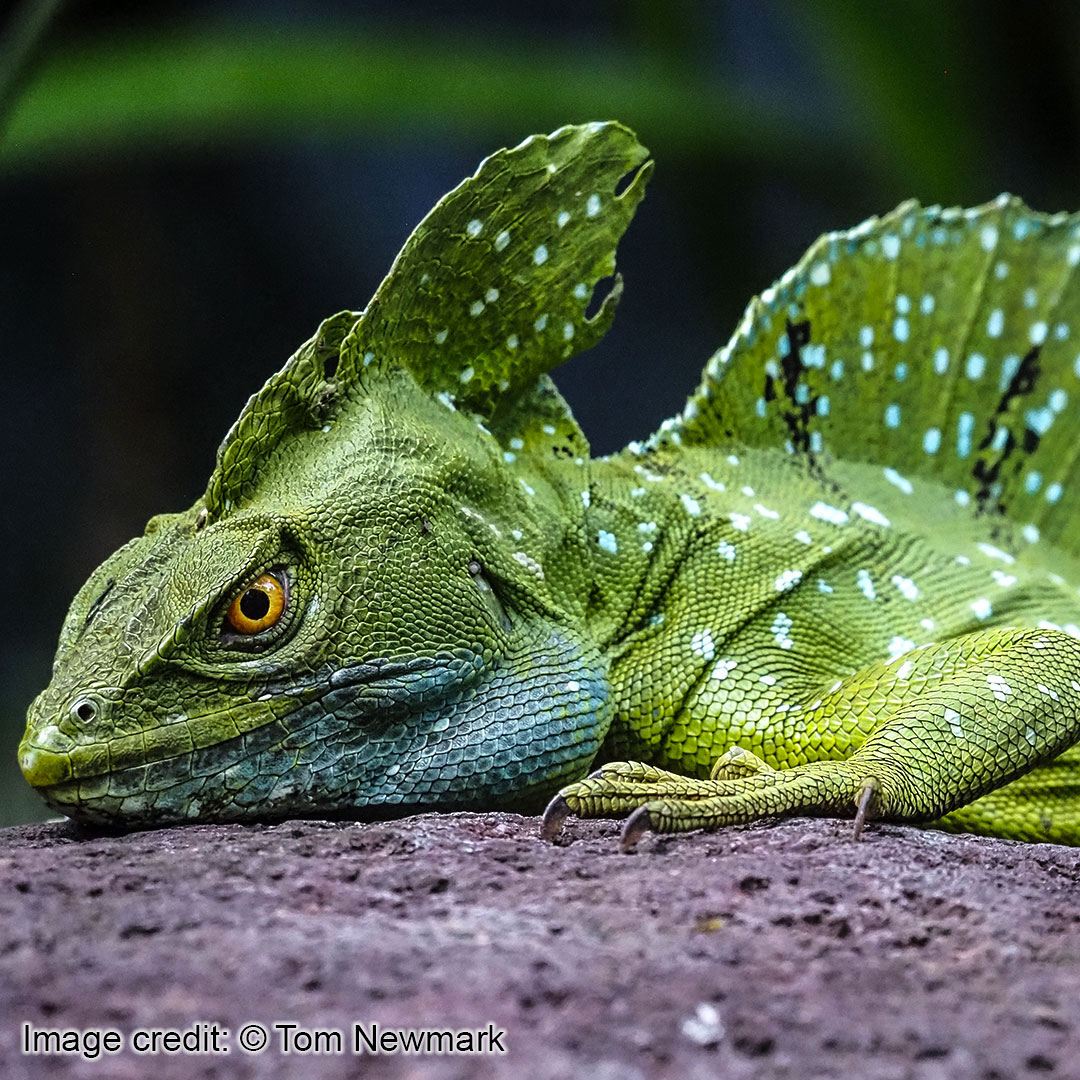
Male emerald basilisk ( Basiliscus plumifrons ) — Finca Luna Nueva Lodge, Costa Rica · Photo: Tom Newmark
We were birding in Caño Negro — one of Costa Rica’s great wetland refuges, herons and anhingas and roseate spoonbills working the channels of the Río Frío — when we spotted a male emerald basilisk gripping a tree about ten meters from the river’s edge. He stared at us with an expression that was one-third suspicion and two-thirds defiance. The birding stopped. Everything stopped. We got too close, and he made his exit. Not through the forest. Across the water. Upright, at a dead sprint, on his hind legs. Jesus Christ Lizard indeed.
The male emerald basilisk is one of the most visually arresting animals on the Caribbean slope of Costa Rica — which is, not coincidentally, nearly the only place in the country you will find him. He is a creature of the Caribbean side, almost entirely absent from the Pacific. The continental divide that runs down the spine of Costa Rica is not just a climatic boundary. It is a biological and cultural one: the Pacific slope shaped by Mesoamerican influence, the Caribbean slope home to the Bribí and Cabécar peoples, whose Chibchan languages and cultural roots extend southward into South America. The emerald basilisk belongs to this world. Emerald green from snout to tail, scattered with turquoise spots, crowned with a dorsal fin that rises off his back like the crest of an angry adolescent punk rocker. Golden eye. Unblinking stare. The look of a creature who has decided, in advance, that whatever you’re about to do — it’s not going to work.
Quick Facts:
Emerald Basilisk
| Scientific name: | Basiliscus plumifrons |
| Family: | Corytophanidae |
| Length: | Up to 90 cm (35 in) including tail; males larger than females |
| Weight: | Up to 200 g |
| Coloration: | Brilliant emerald green with turquoise-white spots; males have dorsal and tail crests |
| Range: | Caribbean slope of Central America — Honduras through Panama; rare on Pacific side |
| Habitat: | Riverbanks, pond edges, rainforest understory near water |
| Diet: | Insects, small vertebrates, flowers, fruit, small mammals, birds’ eggs |
| Superpower: | Runs bipedally across water surfaces at up to 8.4 km/h — the Jesus Christ Lizard |
| Status: | Least Concern (IUCN) — locally common in suitable Caribbean slope habitat |
| At FLN: | Resident near the lodge pool and warm flat stones; occasionally sprints across the pool itself |
The Fin, the Spots, the Stare
Let us be precise about this animal’s appearance, because it deserves precision.
The male emerald basilisk is green in the way that emeralds are green — saturated, electric, almost unnatural. Against the dappled light of a riverine forest, he should be invisible. He is not invisible. He glows. Scattered across that emerald canvas are spots of turquoise and white, each one catching the light differently, so that when he moves he seems to shimmer. The dorsal crest — that spectacular sail of skin supported by elongated vertebral spines — runs from the back of his head down his spine and onto his tail. On an adult male it is substantial, distinctive, unmistakable. It looks exactly like what it is: a display structure designed to impress females and intimidate rivals.
And then there is the gaze. The golden eye, the fixed stare, the expression that Robert De Niro’s Taxi Driver character would recognize instantly. “You lookin’ at me?” The basilisk is not actually aggressive toward humans. It is a prey animal with excellent reason to be wary. But millions of years of evolution have shaped a face that reads, to primate eyes, as pure belligerence. It is not issuing a threat. It is assessing. And it has decided that you are not, quite yet, a problem.
The Mythology and the Reality
The name basilisk comes from Greek — a legendary serpent-king whose gaze could kill. The Harry Potter basilisk, the medieval heraldic beast, the creature of nightmare: all of them trace their lineage to that ancient mythological horror.
This basilisk’s gaze will not kill you. What it will do is hold you in place, binoculars forgotten, while you try to process the fact that an animal this spectacular is standing at the edge of a Costa Rican river looking at you like you’re the one who wandered into the wrong territory.
Which, of course, you have. This is his river. His rocks.
The Physics of Walking on Water
The emerald basilisk runs on water. This is not a metaphor or an exaggeration. It is a biomechanical fact that has fascinated physicists and biologists for decades.
The mechanism works like this: the basilisk’s large hind feet are fringed with scales along the toes that splay outward during the running stroke, creating a momentary air pocket against the water’s surface. The foot slaps down and pushes back before surface tension breaks. At speeds of up to 8.4 kilometers per hour, the lizard is creating and escaping each foothold before it sinks. Juveniles, being lighter, sustain this longer. Large adult males sink into a swimming stroke relatively quickly — but can still cover several meters of open water before that happens.
At Finca Luna Nueva, on warm mornings when the flat reddish stones near our pool have soaked up enough sun, you may witness this firsthand — a flash of emerald launching off the rock and sprinting, improbably, across the water. The Jesus Christ Lizard has entered the pool area. Act accordingly.
An Omnivore at a Rainforest Buffet
For all his theatrical appearance, the emerald basilisk is a practical and opportunistic feeder. Insects make up the core of the diet — beetles, crickets, grasshoppers, whatever the forest and riverbank present. But he is no specialist. Small vertebrates, flowers, fruit, the occasional small mammal, and birds’ eggs are all documented. The basilisk surveys its territory with the calm authority of an animal that has few real predators and an excellent escape strategy.
The Emerald Basilisk at Finca Luna Nueva
The Caribbean slope is this animal’s stronghold, and Finca Luna Nueva sits squarely within it. The lodge’s pool area, garden edges, and the warm mostly flat reddish stones near the water are precisely the microhabitat the emerald basilisk prefers — sun exposure near water, with immediate escape routes in every direction.
The male in this photograph was taken right here at the lodge — the same species, the same posture, the same golden stare we encountered that day in Caño Negro. He let the camera approach. He assessed it with that golden eye. He decided it was tolerable. And that expression — practiced pugnacity — is the one this animal wears everywhere it goes.
Don’t Miss This One
Costa Rica offers no shortage of spectacular wildlife. But there is something particular about the emerald basilisk — the combination of improbable beauty, theatrical presence, and a superpower that violates common sense — that puts it in a category of its own.
It is not a shy animal. It will hold its ground, hold your gaze, and hold its position on those warm flat stones until it decides otherwise. Give it the attention it clearly believes it deserves.
Stop. Look up. Give yourself a moment. You came a long way for this, and it is worth every second.

